AI Receptionist vs Answering Service: What to Choose in 2026
AI Receptionist vs Answering Service: What to Choose in 2026
If your business relies on inbound calls, you are not choosing between “nice to have” options. You are choosing how revenue enters your pipeline.
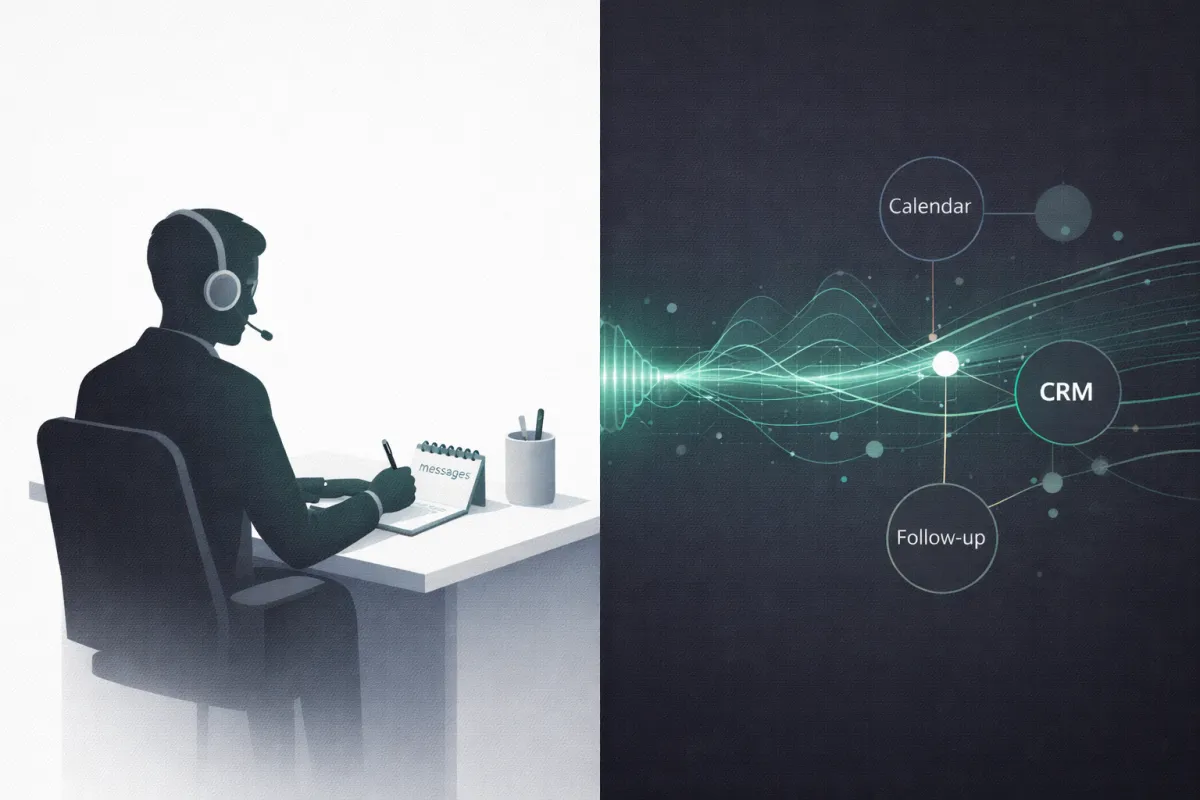
An answering service can stop calls from going to voicemail. An AI receptionist can do that too, but it can also qualify, book, follow up, and write clean data back into your CRM automatically.
This guide breaks down what each option is best at, what to watch out for, and how to choose for 2026.
Quick definitions
Answering service (human)
A third-party team answers calls for you, usually after-hours or overflow. They typically take messages, route calls, and sometimes schedule appointments using basic scripts.
AI receptionist
A voice AI agent that answers calls 24/7, follows your intake rules, can schedule appointments, can send confirmations and follow-ups, and can update your CRM and workflows automatically.
The real difference is not “human vs AI”
It is message-taking vs pipeline execution.
A traditional answering service focuses on “We answered the call.”
A modern AI receptionist focuses on “We captured the lead, qualified it, booked it, and documented it.”
In 2026, that difference shows up in four places.
1) Lead capture: answered is not the same as handled
Most businesses lose money in the gap between “ring” and “resolution.”
Even when a call is answered, businesses often fail to:
Ask the right questions
Confirm the next step
Book the appointment
Follow up if the caller hesitates
A good AI receptionist is built to end the call with an outcome, not just a message.
When an answering service wins
You only need message-taking after hours
Your calls are low-stakes, low-frequency
Your process is “take details, we call back later”
When an AI receptionist wins
Calls are high-intent (service requests, consultations, bookings)
You want fewer “we will call you back” dead ends
You want calls logged cleanly with tags, summaries, and next steps
2) Speed to lead: fast follow-up is a competitive advantage
If a caller does not reach a person, they do not patiently wait for your team to get back to them tomorrow. They call the next business.
Answering services help you answer more calls, but they usually do not run an automated follow-up engine. AI receptionists can.
A strong AI receptionist can:
Send a confirmation text immediately after the call
Send reminders before the appointment
Follow up automatically when a caller does not book
Reactivate missed calls and incomplete intakes
This matters because speed often decides who wins the deal. (See sources below, especially the Lead Response Management study.)
3) Qualification quality: consistent intake beats “best effort”
Answering services depend on:
The operator’s skill
Script compliance
How complex your intake is
How many exceptions come up
AI receptionists can be configured to:
Ask the same required questions every time
Handle branching logic (“If they say X, ask Y”)
Capture structured fields (name, email, service type, urgency, location, budget range)
Summarize the call in plain English for your team
Consistency is not just “nice,” it directly affects operations:
Better scheduling
Fewer back-and-forth calls
Cleaner CRM data
Fewer no-shows
4) Integrations: this is where AI receptionists pull away
Most answering services live outside your systems. They call, email, or text you the message.
AI receptionists can live inside your system:
Calendar booking with real availability
CRM updates (create contact, update fields, tag, move pipeline stage)
Workflow triggers (send welcome sequence, route to the right team, task creation)
Follow-up sequences (missed call, quote follow-up, unbooked consult)
If you are still treating the phone as separate from your CRM, you are operating in 2016.
2026 is “one system,” calls, texts, emails, calendar, CRM, automations, all synced.
What to choose in 2026: a simple decision framework
Choose an answering service if:
You only need basic coverage (after hours or overflow)
Your intake is simple and you do not need structured data
Your volume is low enough that follow-up can stay manual
You are not ready to integrate calls into your CRM workflows
Choose an AI receptionist if:
Calls are a major lead source
Booking speed matters
You want structured intake and clean CRM updates
You want automated follow-ups that feel professional and on-brand
You want reporting, visibility, and control over outcomes
Hybrid approach (often the smartest)
Many businesses start with:
AI receptionist for the top 2–3 call types (new leads, scheduling, FAQs)
Human backup for edge cases or sensitive scenarios
That reduces risk while you lock in predictable performance.
What to ask before you buy either option
For answering services:
What percentage of calls are answered live?
What is the average wait time before pickup?
Can operators book into my calendar, or do they just take messages?
How do you handle training, updates, and exceptions?
How do you ensure consistent intake and accuracy?
For AI receptionists:
Can it book appointments directly into my calendar?
Can it update my CRM fields, tags, stages, and notes automatically?
Does it produce transcripts and call summaries?
How does it handle “I want a human” or complex edge cases?
What does ongoing monitoring and improvement look like?
A cheap solution that is unmanaged becomes expensive fast.
How Agentic Desk Solutions fits into this
Agentic Desk Solutions is not “a chatbot.”
We build and operate a managed AI workforce that can function as your AI receptionist across voice and messaging, with real integrations.
Our approach:
Scope your workflows and outcomes (what should happen on each call)
Build the agent behavior, intake logic, and integrations
Test with real scenarios, refine edge cases
Deploy and stabilize with monitoring and iteration
If you want a receptionist that simply answers calls, an answering service might be enough.
If you want a receptionist that captures leads, qualifies them, books them, follows up, and keeps your CRM clean automatically, that is what we build.
Bottom line
In 2026, the winning question is not “Who answers the phone?”
It is:
“How reliably does my system convert calls into booked outcomes, with clean data and automated follow-up?”
If you want help choosing the right setup for your call volume and workflows, book a consultation and we will map the fastest path to measurable results.

