Signs A Role is Ready to Be Replaced
The Real Operational Friction
You don’t usually notice a “broken role” all at once. You notice the small frictions that keep showing up in different places: the same customer asks for an update twice, a lead sits untouched for three days, an invoice goes out with the wrong details, or a simple request turns into six internal messages. You look at the week and can’t find the moment it went off track—just a trail of minor corrections.
What makes it exhausting is that the work is technically getting done. Calls are returned, tickets are closed, notes are entered, follow-ups happen sometimes. But the business depends on consistency, and the consistency isn’t there. The result is constant cleanup: checking someone’s work, filling gaps, re-asking questions, and pulling status from people who are already “busy.”
This is the kind of friction that feels like a staffing issue, but it behaves more like a structure issue. It shows up as stress, not as a clear failure, until it suddenly becomes a measurable problem.
Why the Common Approach Fails
The common response is to throw capacity at it. Hire an extra coordinator. Add a junior admin. Split the work across more people. On paper, it should reduce load. In practice, it often increases inconsistency because more hands touch the same process without clear operational ownership. Everyone is “helping,” which means no one is accountable for the outcome end-to-end.
Another response is adding tools. A new inbox system. A new tracker. A new board. A new CRM field set. The problem is that tools don’t create defined responsibilities. They create additional surfaces where the same work can be done, half-done, or duplicated. When a step is missed, it’s unclear whether the miss happened because someone didn’t know, someone forgot, or someone assumed a tool would catch it.
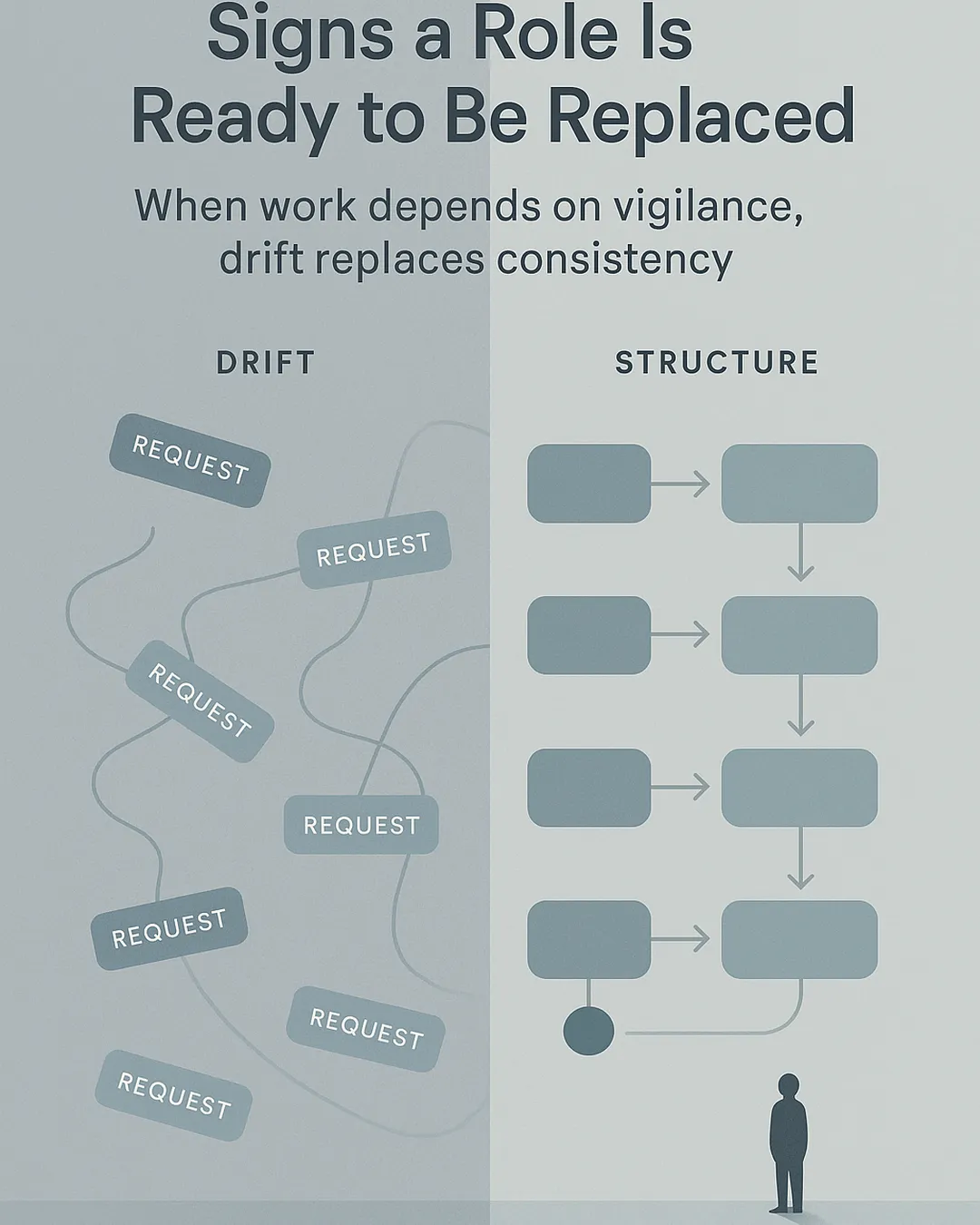
Then businesses layer automations. Notifications, sequences, routing, templates, rules. These can help for a week, until drift sets in. Drift is the quiet gap between how the process was designed and how it’s actually executed under pressure. People adapt. Edge cases appear. Exceptions become normal. The automation remains rigid, and the team starts working around it.
Across all three approaches, the failure modes are consistent: inconsistency becomes baked in, ownership ambiguity grows, drift turns exceptions into routine, and there is no accountability for outcomes—only activity. The business ends up with more motion and less certainty.
Reframe: Roles vs Tasks
The better lens is roles, not tasks. A task is “send the follow-up.” A role is “ensure follow-up happens correctly, on time, and is escalated when it can’t.” The role includes context, prioritization, and the responsibility to keep a workflow intact even when conditions change.
When you define a role properly, you can describe:
- Defined responsibilities: what must happen every time, what “done” means, what quality looks like
- Operational ownership: who is responsible for the outcome, not just the step
- Escalation: what to do when inputs are missing, when rules conflict, or when a decision is required
- Interfaces: what the role receives (inputs) and what it produces (outputs)
This is where AI employees become relevant—not as a magic layer, but as a way to hold a repeatable role to a consistent standard when the role can be clearly defined. The goal isn’t doing “more tasks.” The goal is replacing repeatable roles where the work is stable enough to be owned, measured, and escalated cleanly.
A role is ready to be replaced when the work can be expressed as responsibilities and decisions with known boundaries. If you can’t describe escalation rules, you don’t have a role—you have a person holding tribal knowledge. Replacement is hard in that scenario, whether you hire or use AI employees, because the real system lives in someone’s head.
Practical Implications
So what are the signs a role is ready to be replaced?
First, the work is repeatable and bounded. The same types of requests come in, the same actions are required, and “good enough” quality can be defined. If you can write down the defined responsibilities without hand-waving, you’re close.
Second, the role is primarily about consistency, not creativity. If success is measured by timeliness, completeness, correct routing, clean records, and reliable follow-through, you’re dealing with a repeatable role. When the role fails, it fails in predictable ways: missed steps, late responses, incomplete documentation, and lack of escalation.
Third, outcomes are currently dependent on a specific person’s habits. If things work only when “Sarah is on” or “Mike is watching it,” that’s not a talent issue. That’s a lack of operational ownership at the role level. The business is relying on personal vigilance instead of a defined standard.
Fourth, the role generates constant micro-questions. “Where is this at?” “Did we reply?” “Who owns this?” If leadership is spending time stitching the workflow together, that’s a signal that the role boundaries and escalation are not carrying the load.
When a repeatable role is owned—whether by a person or AI employees—what stops breaking is the handoff. What improves is predictability. Leaders get back time spent checking, reminding, and reworking, and can focus on exceptions and real decisions.
Agentic Desk Solutions helps operators move from scattered task execution to roles with operational ownership, especially when the goal is replacing repeatable roles with AI employees under clear defined responsibilities and escalation rules. If the friction you’re feeling maps to a role that should be consistent but isn’t, we can help you clarify what the role actually is and whether replacement is appropriate. If this sounds familiar, a short consult is the fastest way to scope whether a role can be replaced.

