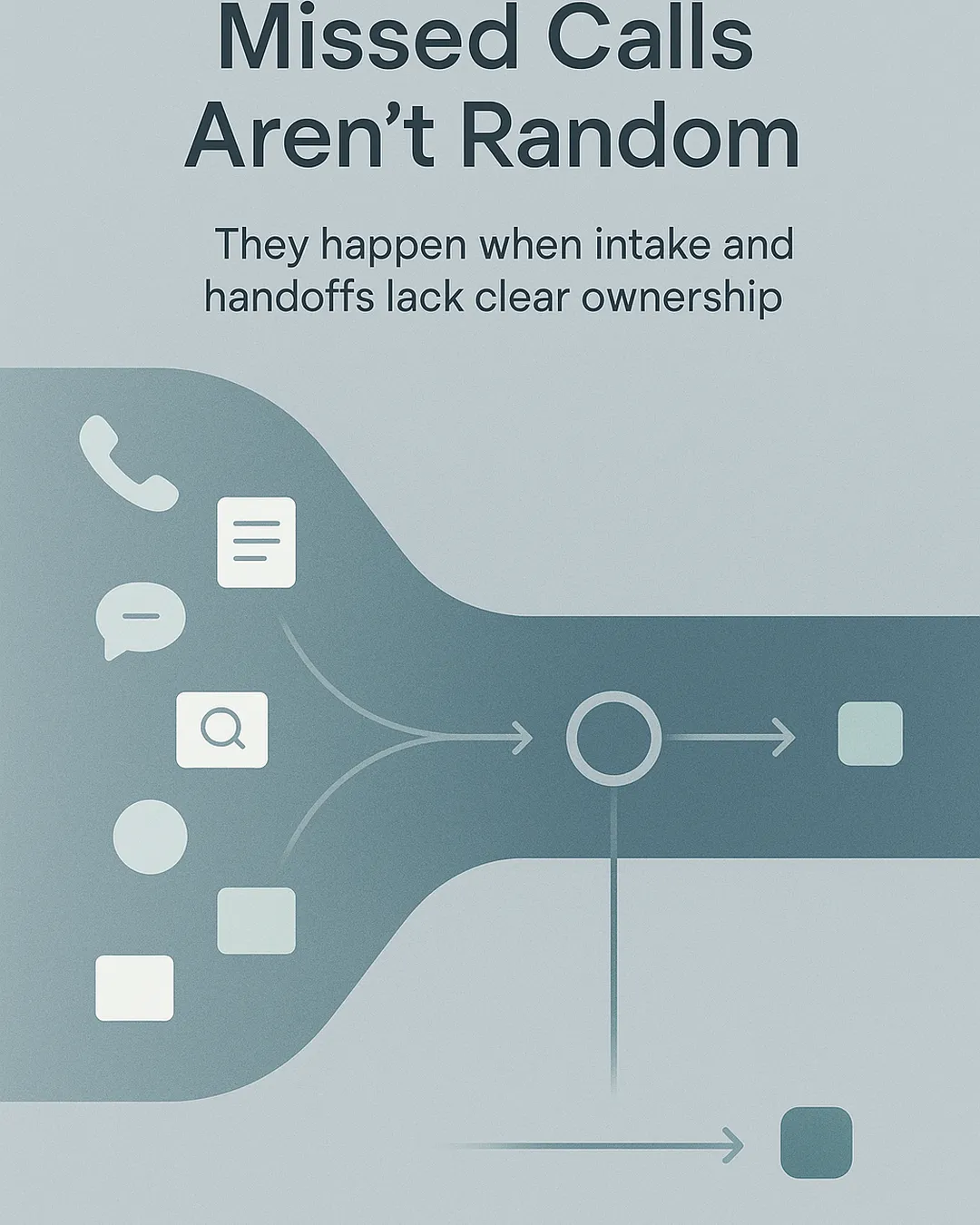
What Actually Causes Missed Calls and Dropped Leads
The Real Operational Friction
It usually doesn’t feel like a “lead management problem.” It feels like a weird, low-grade irritation that shows up in five different places. A prospect calls and gets voicemail during normal business hours. A form submission sits overnight. Someone texts back three days later with “just circling back” and the prospect is gone. A referral comes in, gets forwarded to the wrong person, and no one is sure if it was handled. You find out only when a customer mentions, casually, that they tried to reach you twice.
When you ask the team, everyone has a reasonable explanation. They were on another call. They were in the field. They meant to respond and it slipped. The phone line didn’t ring on their end. The notification got buried. The lead “didn’t look qualified.” The calendar was full. The person who usually handles it was out.
None of this is malicious. It’s normal. The friction is that the business can’t reliably turn “new interest” into “a handled outcome.” And because it’s spread across calls, inboxes, texts, and handoffs, it never looks like one broken thing.
Why the Common Approach Fails
The first instinct is hiring more people. Add another coordinator. Add a part-time admin. Put someone “on phones.” This can help briefly, but it often fails in predictable ways. Coverage becomes a schedule puzzle. When the new hire is out, the role dissolves back into the group. When they’re busy, someone else “grabs it,” and now you’ve created a shared job with no operational ownership. The business ends up paying for effort, not a consistently executed role.
The second instinct is adding tools. A new phone system. A new inbox. A new place where leads are supposed to go. The problem is that tools don’t create defined responsibilities. They create additional surfaces where work can land. If someone must still decide what counts as a lead, where it goes, how fast it must be touched, and what “closed loop” means, then you’ve just created new failure points. People will interpret fields differently. Notes will be incomplete. Dispositions will be skipped. The data becomes a story people tell after the fact.
The third instinct is layering automations. Auto-replies, sequences, routing rules, reminders. These can reduce manual steps, but they often increase inconsistency and drift. Routing rules are only as good as the inputs, and inputs decay when humans are rushed. Reminders are only as good as the person who receives them, and busy teams habituate to alerts. Sequences send messages that don’t reflect context, and prospects reply with nuance that no one owns.
Across all three approaches, the same failure modes show up:
- Inconsistency: response times vary, qualification varies, and follow-up varies.
- Drift: what “we do” changes silently over weeks as people adapt.
- Ownership ambiguity: no one can say, with certainty, who owns the outcome for each lead.
- No accountability: you can’t correct what you can’t assign.
Reframe: Roles vs Tasks
Missed calls and dropped leads don’t primarily happen because people forget tasks. They happen because the business treats lead handling as a set of tasks sprinkled across multiple jobs.
A task sounds like: “Call them back.” “Send the quote.” “Log it.” “Book the appointment.” “Follow up next week.” Those tasks can be done by anyone, which means they are owned by no one. When pressure rises, tasks migrate to the bottom of priority lists. When someone new joins, they mimic whatever they saw last week. When a manager asks for an update, the answer is a mix of memory, scattered notes, and best guesses.
A role is different. A role has defined responsibilities, clear operational ownership, and explicit escalation. It answers questions like:
- What counts as a new lead, and where does it enter?
- What is the response-time requirement by channel (call, form, text, referral)?
- What is the minimum information to collect before handoff?
- What is the qualification standard, and who can override it?
- What is the follow-up cadence, and when is a lead considered closed?
- What happens when the prospect can’t be reached?
- When does the role escalate to a human, and to whom?
Once you define the role, you can evaluate whether it is repeatable enough for replacing repeatable roles. This is where AI employees come in—not as a vague “automation layer,” but as role-based operators that can own defined responsibilities, execute consistently, and escalate when conditions fall outside the rules. The point isn’t that a machine can “do everything.” The point is that a role with clear boundaries can be owned without relying on individual memory and daily prioritization.
Practical Implications
When a lead-handling role is owned, several things improve quickly, even before you change anything else.
First, consistency replaces heroics. Prospects get a predictable experience: same-day touches, clear next steps, and fewer dead ends. The business stops relying on one sharp person who “just knows” how to keep the inbox clean or how to save a shaky lead. That’s operational ownership showing up as stability.
Second, handoffs stop breaking. The intake role becomes responsible for creating a usable package for the next step—sales, scheduling, service, estimating. That package is defined: required fields, required notes, required attachments, and what gets escalated. Downstream teams stop complaining that they’re “starting from scratch” on every lead.
Third, leaders get time back because the questions change. Instead of, “Did anyone call them?” you can ask, “What percentage were contacted within our standard?” Instead of chasing individual threads, you review exceptions and escalations. You stop being the routing brain for the business.
Fourth, you can actually measure what matters. Not vanity metrics, but operational ones: missed call rate, time-to-first-touch, contact rate, qualified-to-booked rate, and closed-loop rate (every lead ends with a logged outcome). Those metrics only become reliable when the role has defined responsibilities and a single owner.
This is also where replacing repeatable roles becomes practical. If the work is repeatable, bounded, and escalation is defined, AI employees can maintain coverage, execute the standards without drift, and keep the loop closed—while humans focus on the conversations and judgment calls that truly require them.
Soft Close + CTA
Agentic Desk Solutions helps operators create role clarity and operational ownership, then assess whether replacing repeatable roles with AI employees is appropriate for the work. If missed calls and dropped leads are showing up as constant background noise, it’s usually a sign the role isn’t owned as a role. If this sounds familiar, a short consult is the fastest way to scope whether a role can be replaced.

