What to Fix Before Adding AI Automation to Operations
The friction is operational, not technical
Most teams do not struggle with AI automation because they lack access to capable technology. They struggle because the work they want to automate has never been made sufficiently explicit.
Consider a marketing content workflow. A request may begin with a loose brief in one place, source material in another, approval expectations held by an account lead, and publishing requirements known only by the person who usually completes the task. The process may work when that person is available, but it is not yet ready to run consistently.
The same pattern appears in analysis and reporting. Inputs arrive late, definitions change, owners disagree on what needs review, and exceptions are resolved through private messages. Adding automation to that environment can increase output volume without improving the quality or reliability of operations.
Before deployment, an Operations Risk Manager or Compliance Lead should be able to answer basic questions: Who owns the request? What inputs are required? What standard determines whether an output is acceptable? Who can approve it? What happens when data is missing, a claim cannot be supported, or a deadline changes?
Recent release activity across major AI platforms makes it easier to connect context and support more kinds of work. That makes operating discipline more important, not less. Technical access can arrive quickly; clear ownership, review standards, and escalation paths still need to be designed.
Why the common approach fails
A common approach is to begin with the most visible task: generate a draft, summarize a document, prepare a report, or send an update. The team connects available information, writes a prompt, and treats a promising early output as evidence that the workflow is ready.
That approach fails when the underlying process has unresolved decisions. If the intake is inconsistent, the automation receives inconsistent instructions. If approval authority is unclear, reviewers duplicate effort or assume someone else will decide. If exceptions have no path, the work either stalls or moves forward with unexamined gaps.
Automating a broken sequence does not remove ambiguity. It repeats ambiguity faster.
Another frequent mistake is treating review as a final checkpoint rather than a designed part of the workflow. A single approval gate added at the end cannot compensate for unclear inputs, missing source material, or a lack of defined acceptance criteria. Teams need to know what should be checked, by whom, and at which state of the work.
The aim is not to remove human judgment from consequential work. It is to reserve judgment for decisions that actually require it, while making recurring work more consistent from intake through completion.
Reframe AI automation as an approved operating system
The useful question is not, “What task can we automate first?” It is, “Which recurring work can follow a defined operating path end-to-end?”
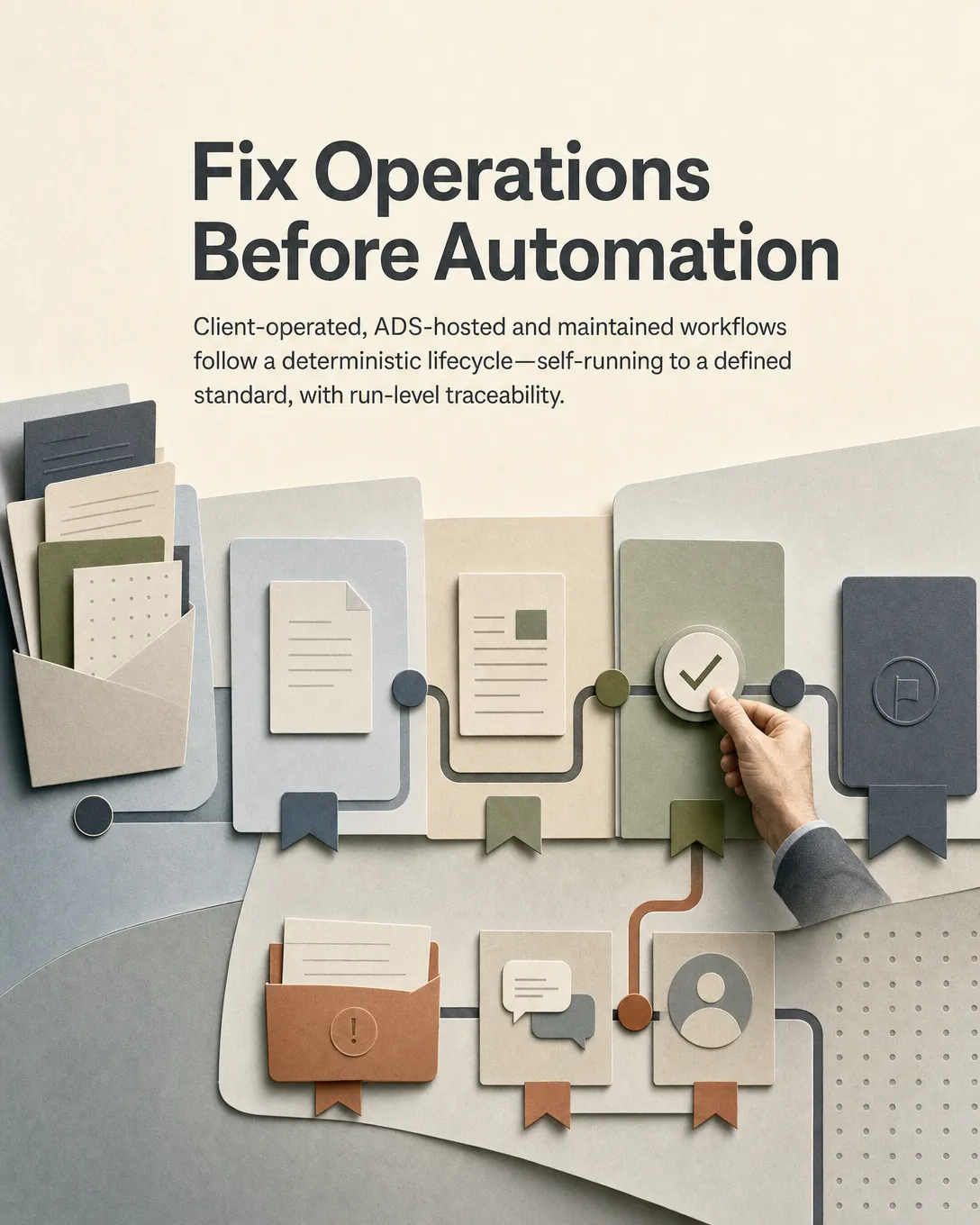
A custom AI operations system should be configured around that path. It needs a deterministic lifecycle that governs intake, execution, approvals, escalation, and completion. Each stage should have a clear purpose, accountable owner, required information, and decision rule.
For a content workflow, that lifecycle may begin with a validated brief and approved source material. Execution can then prepare a draft against the stated requirements. A reviewer evaluates the result through clear approve/revise/reject steps. Only human-approved outputs move to publishing, while incomplete or disputed work follows an escalation path.
This is approval-gated execution, not a free-form stream of generated material. It gives the client team control over where quality, legal, brand, and operational decisions belong.
A system designed this way can be self-running to a defined standard without removing client authority. The configured workflow handles ordinary, defined cases consistently, while the client decides priorities, approvals, and exceptions. That distinction is essential for operations where context changes and accountability matters.
The other requirement is run-level traceability. Each governed run should record its state and outcome: what entered the workflow, whether the required conditions were met, where approval occurred, what exception was raised, and whether the work was completed or returned for revision. This creates an auditable run history that supports review without relying on memory or scattered messages.
Practical fixes to make before deployment
Define ownership and acceptance criteria
Assign an accountable owner for each workflow, not just for the technology around it. That owner should define the purpose of the work, required inputs, quality threshold, and approval process.
For example, “produce a campaign brief” is too broad. A usable standard identifies the required customer context, offer details, voice requirements, source references, format, reviewer, and publish conditions. Automation works from instructions that can be checked, not assumptions that live in someone’s head.
Standardize intake before execution
A workflow should not begin until it has the information needed to proceed. Define mandatory fields, acceptable source formats, timing expectations, and the conditions that require escalation.
This prevents a familiar failure mode: a system produces polished content or analysis from incomplete context, and the team spends more time correcting it than it would have spent preparing the request properly. Better intake is often the highest-value operating fix available.
Design approval and exception paths
Identify where human-approved outputs are necessary and make those handoffs explicit. A Compliance Lead may need to approve claims before publication. An Operations Risk Manager may need visibility when a required input is absent or a workflow departs from its normal conditions.
Also define what happens when the process cannot continue. A useful escalation path names the responsible person, the information they receive, and the decision they need to make. Exceptions should not disappear into an informal inbox.
Measure workflow reliability, not output volume
More drafts, summaries, or reports do not automatically mean better operations. Track whether requests arrive complete, how often work needs revision, where approvals slow down, why exceptions occur, and whether completion meets the intended standard.
These measures show which operating fixes are working. They also identify when the configured system needs improvement because the business process, approval criteria, or inputs have changed.
Build on control, then expand
Agentic Desk Solutions builds, hosts, maintains, and improves the operating platform configured for your business and the tools you already use. The configured system is client-operated and ADS-hosted and maintained: your team retains operational control, uses the system day to day, and decides priorities, approvals, and escalations. With a deterministic lifecycle, self-running to a defined standard, and run-level traceability for each governed run, AI-powered business operations can support recurring work with clear control points. Book a consultation to map your highest-impact workflow.
Sources
- ChatGPT Enterprise & Edu - Release Notes | OpenAI Help Center — https://help.openai.com/en/articles/10128477-chatgpt-enterprise-edu-release-notes
- ChatGPT — Release Notes | OpenAI Help Center — https://help.openai.com/en/articles/6825453-chatgpt-release-notes
- ChatGPT is now a partner for your most ambitious work | OpenAI — https://openai.com/index/chatgpt-for-your-most-ambitious-work
- OpenAI Newsroom | Recent news | OpenAI — https://openai.com/news/company-announcements