AI Platform Shifts Operators Should Track This Quarter
Release notes are now an operational input
The operational friction around AI platform shifts is rarely a lack of announcements. It is the opposite: changes arrive across model access, platform administration, integrations, workflow surfaces, and business editions, while teams still need reliable day-to-day operations.
Google’s current release notes for the Gemini Enterprise Agent Platform, Gemini Enterprise, and Gemini Enterprise Business edition are useful reminders that platform movement should not be treated as background noise. For an Operations Leader or Technology Director, each update can affect how a recurring workflow is configured, reviewed, escalated, or recorded.
The question is not, “What new capability is available?” The more useful question is, “What does this change mean for our approval process, operating authority, and recorded workflow state?”
That shift matters when AI-powered business operations move beyond one-off experimentation. A platform change can influence the reliability of content production, reporting, analysis, intake, or internal operations even when the underlying business goal has not changed.
Why feature chasing fails
The common response to AI platform movement is feature chasing. Teams see a new release, test it in isolation, and then attempt to insert it into an existing workflow after the fact. That creates a collection of promising capabilities without a clear answer to who owns decisions, where approvals occur, or how exceptions are handled.
A late-stage review is not enough. If the only control is a final check before publication, errors or policy mismatches may already have moved through several steps. The team may not know which inputs shaped the result, what rules applied, or whether a similar issue has occurred before.
This approach also makes platform updates feel disruptive. Every release becomes a potential rebuild because the workflow was never designed around stable controls. Operators spend time comparing features instead of deciding whether a change improves a defined business process.
The better standard is not to adopt every platform change. It is to assess whether the change strengthens a governed workflow. If it does not improve execution quality, review clarity, or operational visibility, it may not deserve immediate attention.
The approved-system reframe
An AI operations platform should be configured for your business, not assembled around generic demonstrations. That means defining the business objective, approved inputs, decision points, exception paths, and completion conditions before a new platform capability is introduced.
In this model, the configured workflow is self-running to a defined standard. That does not remove human judgment. It means recurring work can proceed through known stages without requiring people to manually coordinate every handoff. An approval gate remains in place where business judgment, brand responsibility, policy interpretation, or publish authority is required.
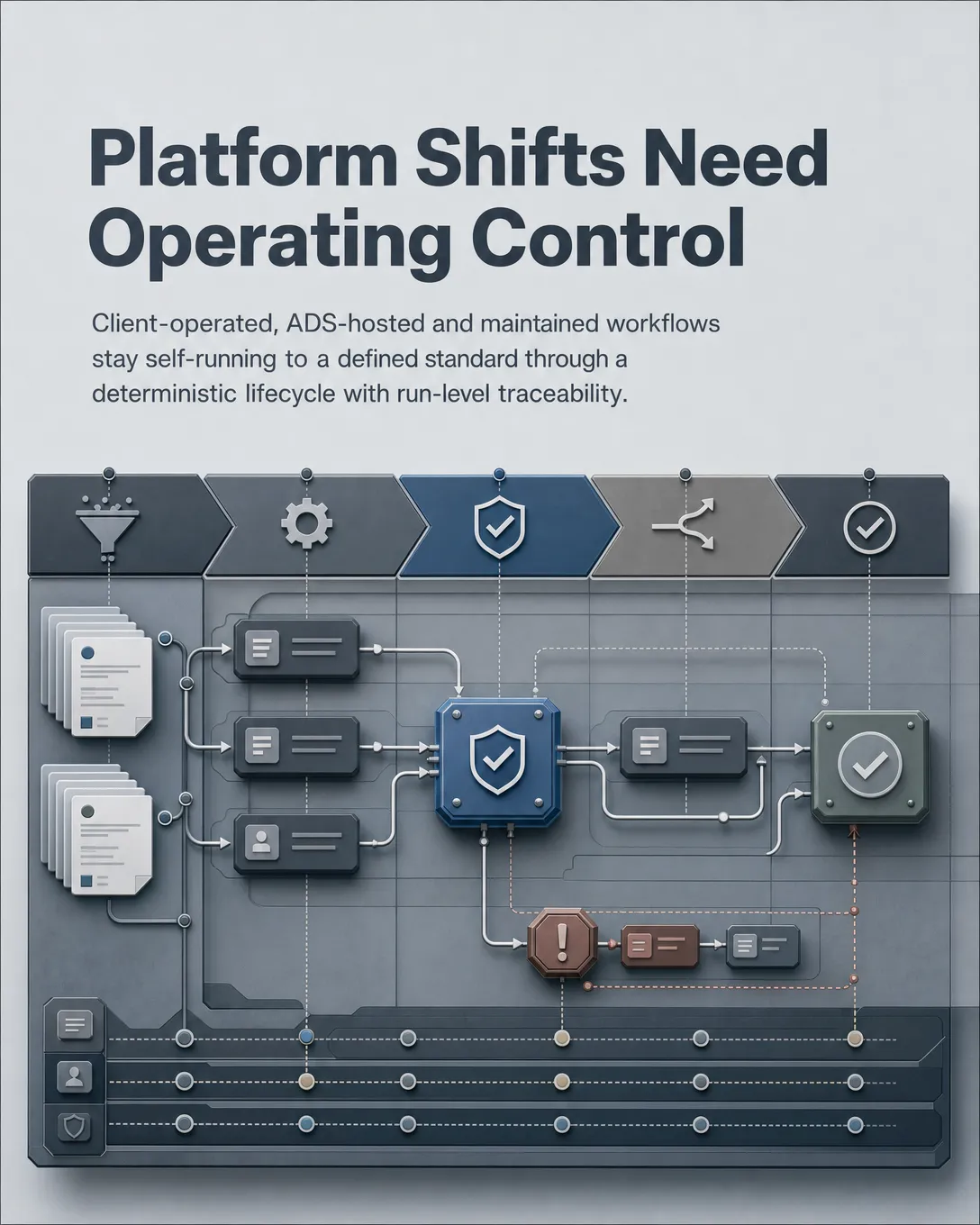
A deterministic lifecycle governs intake, execution, approvals, escalation, and completion. Each stage has a purpose:
- Intake establishes the request, required context, and applicable rules. - Execution performs the configured workflow steps. - Approval confirms that human-approved outputs meet the relevant standard. - Escalation routes ambiguity, missing information, or exceptions to the right person. - Completion records the result and closes the run.
Run-level traceability is essential here. It gives operators a clear record of the state and outcome of each governed run, including logged approval and publish outcomes, exceptions, and unresolved items. That record is more useful than a vague sense that a workflow “worked” because it supports review, refinement, and accountability.
This is where business-specific approval boundaries matter. A content workflow may need editorial approval before publication. A reporting workflow may need a finance or account owner to validate key figures. An analysis workflow may require a subject-matter reviewer when source confidence is low. The platform should reflect those boundaries rather than assume every output deserves the same treatment.
Practical implications for operators this quarter
Review release notes through workflow impact
Operators should review platform updates as change-control inputs. Instead of scanning for the most impressive feature, ask:
- Which recurring work could this affect? - Does it alter the inputs, execution path, or output format? - Does it change who needs to approve the result? - Can the workflow still preserve its approval gate and recorded workflow state? - Does it create a new exception type the team needs to handle?
Not every release requires action. The goal is a short, repeatable assessment that distinguishes useful changes from distractions. This gives leaders a way to make deliberate platform decisions without turning every update into an operational fire drill.
Test bounded workflows end-to-end
For marketing content, start with a defined workflow rather than a broad mandate. A team might test a content brief through source review, drafting, human approval, revision, and publication readiness. The test should clarify where a new platform capability helps and where the existing operating standard should remain unchanged.
Testing a workflow end-to-end also reveals whether a release creates hidden friction. If a new capability changes output consistency, adds review burden, or makes exceptions harder to identify, that is an operational finding—not a reason to force adoption.
The important measure is whether the workflow remains clear to the people responsible for it. Teams should be able to see what entered the process, what occurred during execution, where approval happened, and why the run reached its final state.
Preserve client authority as platforms change
Platform movement is a reason to clarify responsibility, not blur it. The client should retain authority over priorities, policies, approvals, and exceptions. The client’s team uses the system day to day, decides what work enters the workflow, and determines when an output is ready for use.
That structure supports a client-operated system even as platforms evolve. It also prevents a common failure mode: treating a platform update as permission to remove the controls that made the workflow dependable in the first place.
Keep control where the work happens
Agentic Desk Solutions builds, hosts, maintains, and improves the operating platform, while the client and its team retain operational control and use the system day to day. The system is client-operated and ADS-hosted and maintained, with configured workflows self-running to a defined standard and governed by a deterministic lifecycle. Agentic Desk Solutions helps teams evaluate relevant platform shifts while preserving approval ownership, run-level traceability, and clear exception handling. Book a consultation to map your highest-impact workflow.
Sources
- Gemini Enterprise Agent Platform release notes — https://docs.cloud.google.com/gemini-enterprise-agent-platform/release-notes
- Gemini Enterprise release notes — https://docs.cloud.google.com/gemini/enterprise/docs/release-notes
- Gemini Enterprise – Business edition release notes — https://support.google.com/g/answer/16719009