Analysis Memo Production Works When It’s Treated as an Owned Role
Opening: the operational friction
In many professional services firms, analysis memos sit in an awkward middle zone: important enough to influence client decisions, but produced in a way that resembles a recurring scramble. Someone pulls numbers from a spreadsheet, someone else checks a dashboard, a third person tries to reconcile definitions, and the final writer stitches it together under time pressure. The result might be “good enough,” but it’s rarely consistent.
Over time, the friction shows up in predictable ways: different teams interpret the same metric differently; narrative tone drifts from memo to memo; and the people responsible for client outcomes spend their time chasing inputs instead of making judgments. When questions come back from a client—“Where did this figure come from?” or “Why does this recommendation differ from last month?”—the organization has to reconstruct the path after the fact. That reconstruction is slow, and it’s risky.
This is where AI automation can help, but only when it is implemented as part of an operational system with a clear approval process, human-approved outputs, and a full audit trail—especially for recurring work that directly impacts client trust.
Why the common approach fails
Most firms try to improve memo production by adding isolated fixes: a new template, a shared drive of “approved” snippets, or a prompt pasted into a document. These approaches often reduce effort in one spot while increasing variability elsewhere, because the underlying work is not treated as a governed role with inputs, checkpoints, and explicit acceptance criteria.
The first failure mode is unclear ownership. If the Strategy Lead thinks the memo is “just reporting,” while the Client Advisory Director sees it as an advisory artifact, no one defines the operating standard. That leads to silent conflicts: what counts as a source of truth, which metrics are allowed, how to handle missing data, and what level of confidence is required before making a recommendation.
The second failure mode is task-by-task automation without traceability. When an analyst runs a one-off process to summarize data, there’s often no reliable log of what was pulled, when it was pulled, and what transformations occurred. If a KPI changes because of a late data refresh or a definition change, the memo may look inconsistent without anyone noticing until a client flags it. A “quick fix” becomes ongoing exception handling.
The third failure mode is narrative drift. Even when numbers are correct, interpretation can vary because the logic isn’t encoded. One person emphasizes growth rate; another focuses on efficiency; a third changes how segments are grouped. The firm may think it has a “standard memo,” but in practice each version reflects whoever assembled it that week.
Finally, common approaches underuse what the market has made possible: modern model platforms are increasingly packaged for enterprise use with clearer release notes, admin controls, and deployment options (as reflected in updates from Google’s Gemini product and enterprise documentation, and OpenAI’s release notes). That doesn’t mean outputs are automatically safe or consistent—but it does mean you can design AI automation into controlled workflows rather than treating it as an informal add-on. Without governance, the improved capability just increases the speed at which inconsistent memos get produced.
Reframe: approved systems vs task-by-task scrambling
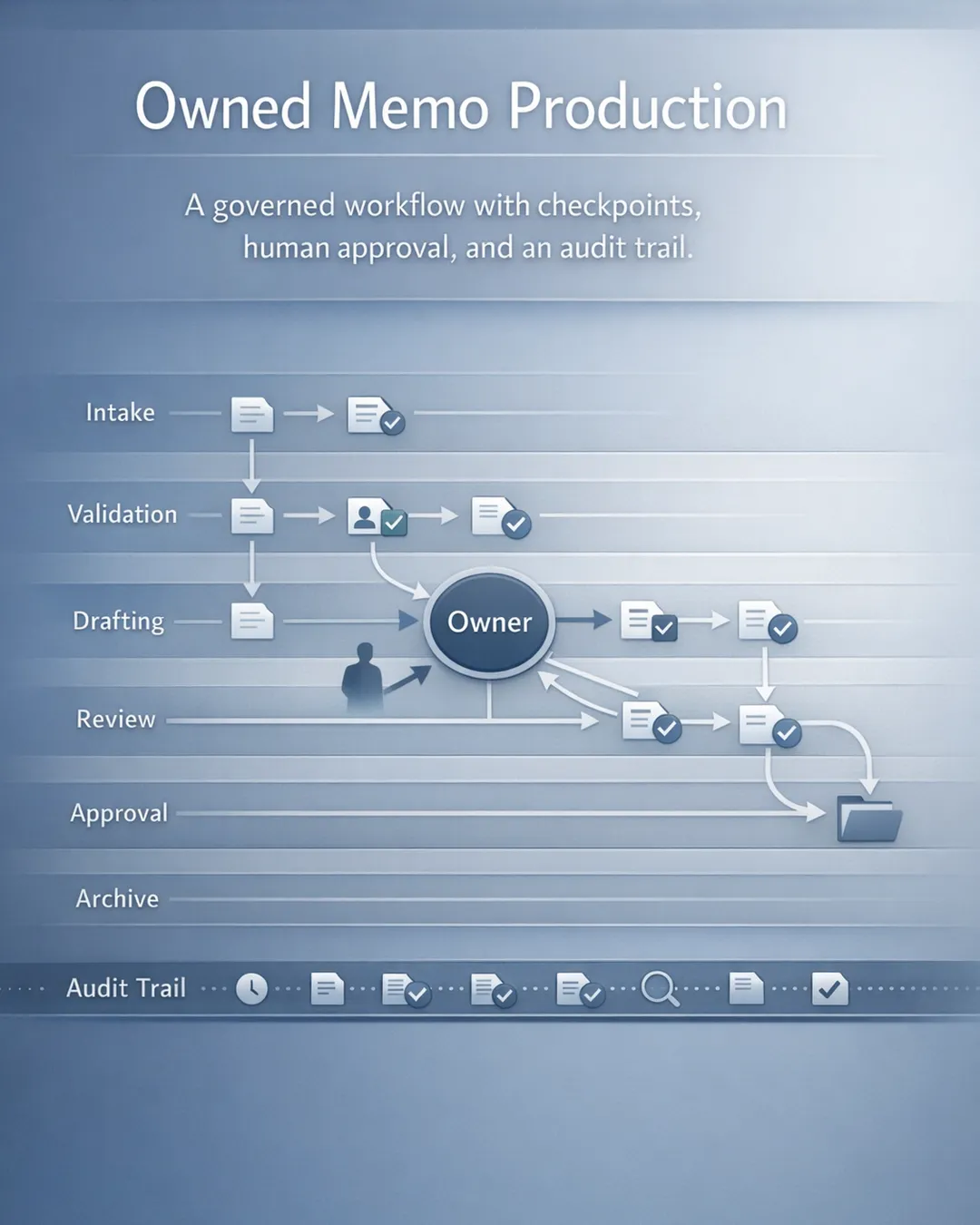
Analysis memo production works when it is treated as an owned role contract: a defined set of responsibilities with explicit inputs, validation rules, and an approval gate before distribution. Instead of “someone generates a memo,” you have a repeatable system that produces a draft, routes it through review, and records what happened.
In practice, this means designing the memo workflow the way you would design any other client-facing operation:
Define the role contract
Start by specifying the memo’s operating definition: what it is, what decisions it supports, what sources are authoritative, and what must be included every cycle. This is where the Strategy Lead and Client Advisory Director align on standards—so the memo is not merely a report, but a governed advisory deliverable.
Make the workflow checkpoint-based
Rather than one monolithic step (“write the memo”), the system runs checkpoint-based execution. Common checkpoints include: data retrieval and timestamping, metric calculation and reconciliation, anomaly detection, narrative drafting, and final approval. Each checkpoint can be reviewed, and each can be improved without breaking the whole process.
Require human-approved outputs
For professional services, the memo should be human-approved before it reaches a client. AI automation handles the recurring work—assembling the evidence, producing the first draft, highlighting deltas—but the accountable leader confirms the narrative and recommendation. This is not about slowing things down; it’s about ensuring the firm’s judgment is explicit and defensible.
Keep a full audit trail
A full audit trail is the difference between “we think this is right” and “we can show how we got here.” The system should record the data sources used, the calculation steps, the version of the memo draft, the reviewer’s approval, and any overrides. When a client asks for clarification, you can answer quickly and consistently.
When analysis memo production is treated as an owned role supported by AI automation, you stop optimizing for heroic effort and start optimizing for dependable delivery across recurring work.
Practical implications
This reframing changes day-to-day operations in ways that business operators will recognize immediately.
First, it standardizes what “done” means. Memos stop being subjective artifacts and become outputs that meet defined acceptance criteria: correct period coverage, consistent segmentation, approved definitions, and documented assumptions. Review becomes faster because the reviewer is evaluating judgment, not hunting for missing pieces.
Second, it reduces hidden rework. Many firms spend more time correcting memos than producing them: finding the right dataset, reconciling a metric, reformatting charts, rewriting an inconsistent section. With end-to-end workflow automation that is configured to your data and your tools, the system handles the repeatable steps and surfaces exceptions. Humans focus on decision quality.
Third, it improves client trust during inevitable changes. Metrics definitions evolve, data sources get upgraded, and reporting periods shift. With a full audit trail and explicit checkpoints, you can explain changes cleanly: what changed, when, why, and what the impact was. That turns “why is this different?” into a managed communication rather than a scramble.
Finally, it clarifies staffing and accountability. The Strategy Lead retains ownership of interpretation; the Client Advisory Director governs client-facing standards; analysts are freed from repetitive assembly work and can focus on deeper analysis. AI automation becomes part of operations, not a side project.
Final paragraph: bringing it together with Agentic Desk Solutions
Agentic Desk Solutions designs and operates custom AI operations systems configured for your business. For analysis memo production, that means building a governed workflow around your existing data, your tools, and your approval process—so recurring work produces human-approved outputs with a full audit trail. The emphasis is operational: checkpoint-based execution, clear role ownership, and repeatable delivery that your team can stand behind with clients. If you’re ready to treat analysis output as an owned role rather than ad hoc spreadsheet interpretation, we can map the workflow and define the controls. Book a consultation to map your highest-impact workflow.
Sources
- Official Gemini news and updates | Google Blog — https://blog.google/products-and-platforms/products/gemini
- ChatGPT — Release Notes | OpenAI Help Center — https://help.openai.com/en/articles/6825453-chatgpt-release-notes%2525252525252525252525252525252525252525252525252525252525252525252525252525252525252525252525252525252525252525252525252525252525252525252525252525252525252525252525252525252525252525252525252525252525252525252525252525252525252525252525252525252525252525252525252525252525252523.xls
- Gemini Enterprise release notes | Google Cloud Documentation — https://docs.cloud.google.com/gemini/enterprise/docs/release-notes
- Gemini Enterprise Agent Platform release notes | Google Cloud Documentation — https://docs.cloud.google.com/gemini-enterprise-agent-platform/release-notes