Why Analysis Pipelines Need Validation Before Narrative Output
The Story Is Often Requested Before the Data Is Ready
Business teams rarely ask for a spreadsheet review. They ask for a clear answer: What changed, why did it change, and what should happen next?
That pressure is understandable. A Reporting Lead may need a weekly performance summary before a leadership meeting. An Operations Director may need an explanation for a missed target while planning the next shift. In both cases, the narrative is the visible deliverable. But it should not be the first thing an analysis pipeline produces.
When a summary is drafted before the underlying numbers have passed defined checks, persuasive language can give uncertain data more authority than it deserves. A percentage may use the wrong denominator. A week-over-week comparison may cover mismatched date ranges. A revenue change may be correct in total but assigned to the wrong region, channel, or product category.
The resulting narrative can still sound coherent. That is the risk. A well-written explanation makes people less likely to question the figures beneath it.
Public release notes from AI providers are a useful reminder that capabilities and product behavior continue to change. That pace makes stable business controls more important, not less. AI automation for reporting needs a dependable process that distinguishes a verified result from a plausible draft.
Why the Draft-First Method Breaks Down
The common approach is simple: pull data, ask for a summary, then have someone review the wording. It feels efficient because the team gets a readable output quickly. In practice, it shifts analytical verification into a late-stage editorial task.
That creates several problems.
First, reviewers must inspect both the logic and the prose at once. Instead of asking whether a conclusion is well supported, they are forced to trace calculations, source dates, metric definitions, and exceptions while also deciding whether the writing is clear.
Second, narrative review can become subjective. A stakeholder may approve a summary because it sounds reasonable, even when an important comparison has not been reconciled. If a concern is spotted later, the team has to work backward through source files and draft versions to identify where the claim originated.
Third, an unverified narrative can spread before anyone has resolved the data issue. Once a statement appears in a leadership email, client update, or operations review, it can become the working assumption for decisions. Correcting it afterward costs more than holding the output at an approval gate before publication.
The problem is not that business analysis needs narrative. It does. The problem is treating narrative as the mechanism for discovering whether the analysis is sound.
Validation Is a Governed System, Not a Final Review
A stronger analysis workflow separates factual validation from interpretation. The system should establish that the inputs, calculations, and business rules are acceptable before it generates or approves a narrative conclusion.
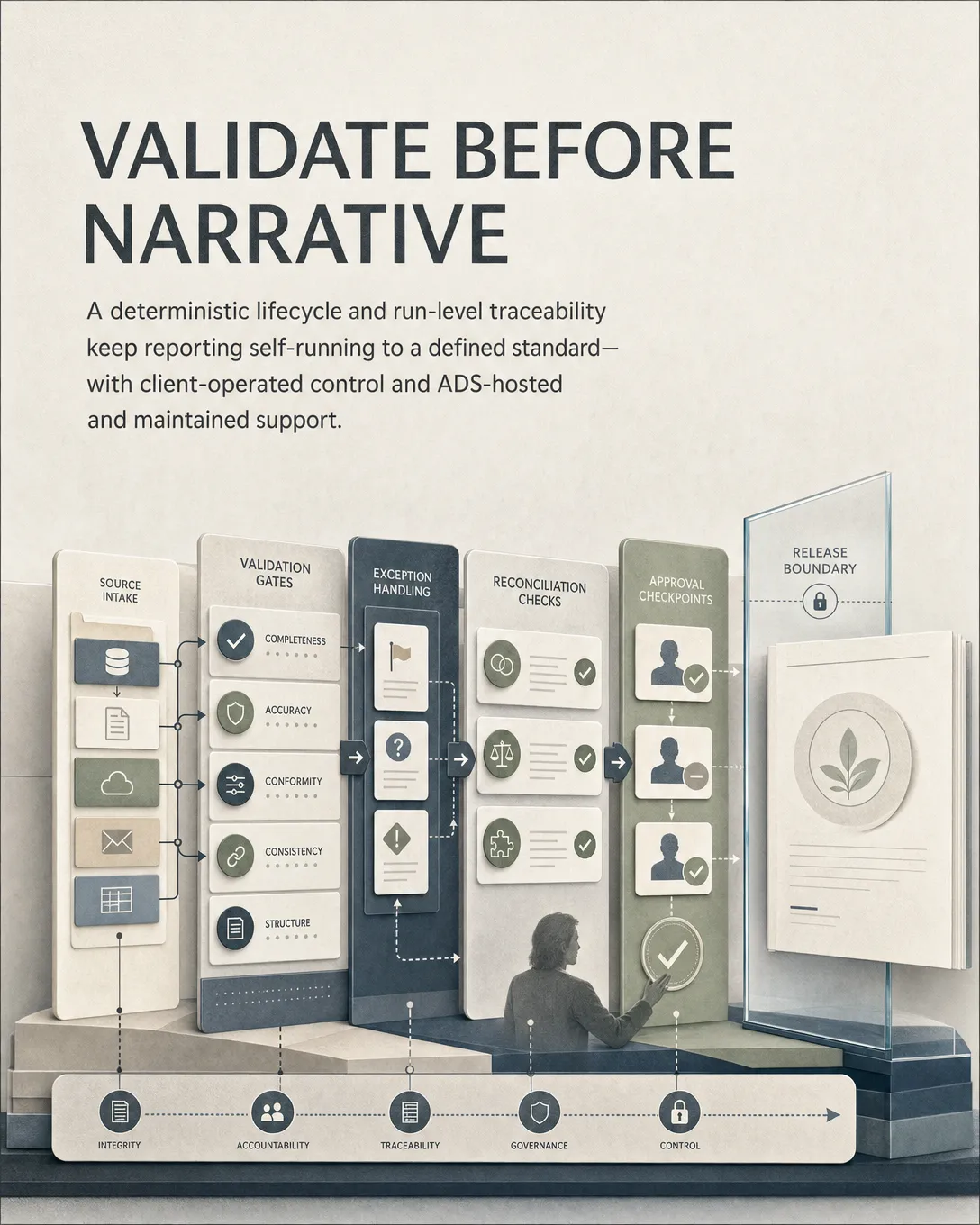
This begins with a deterministic lifecycle governing intake, execution, approvals, escalation, and completion. At intake, the workflow identifies the expected sources, reporting period, metric definitions, and required output. During execution, it checks source availability, schema changes, duplicate records, missing values, calculation logic, and comparison periods.
A second pass can reconcile totals across source systems and flag material variances. A third can test business-specific rules: whether a metric is within a credible range, whether a known event explains an outlier, or whether a category mapping changed. Only then should the workflow connect validated findings to narrative claims.
This does not mean every report needs an extensive manual review. It means the workflow should make the right state visible. A clean run can proceed through approval-gated execution. A run with a failed reconciliation, stale source, or unexplained variance should escalate with a clear exception rather than quietly producing a confident summary.
The approval process should also distinguish decisions. Clear approve/revise/reject steps give reviewers a way to confirm a report, request changes, or stop publication when evidence is incomplete. Human-approved outputs are not a fallback for weak automation; they are the point at which accountable business judgment is applied to verified analysis.
Run-level traceability makes this practical at scale. For each governed run, the system records its state, validation results, exceptions, logged approval and publish outcomes, and final destination. That auditable run history lets a team answer direct questions: Which source version was used? What checks passed? Who approved the interpretation? Was the report published or held?
What a Reliable Analysis Workflow Changes Day to Day
Validation-first design changes how a team spends its attention. Rather than rereading every summary from scratch, reviewers can focus on exceptions, material changes, and decisions that need context.
For a Reporting Lead, that may mean receiving a report that already identifies whether current-period totals reconcile with the source system and whether a variance crossed a defined threshold. The lead can spend time assessing the cause of a verified change rather than recalculating a basic metric.
For an Operations Director, it can mean seeing the operating impact alongside the evidence: a confirmed rise in backlog, the locations affected, the relevant time window, and any source limitations that require caution. The narrative becomes a structured explanation of validated facts, not an assumption that the facts are correct.
To make that work, teams should define a few items before automating recurring work end-to-end:
Establish the acceptance criteria
Specify the required sources, refresh expectations, reporting windows, data-quality thresholds, calculation definitions, and escalation conditions. A workflow cannot reliably validate an undefined standard.
Connect every claim to evidence
A summary should be able to point back to a validated metric, comparison, or exception. Claims such as “demand weakened” or “conversion improved” need an agreed measurement basis, not just a reasonable-sounding interpretation.
Design approvals around decisions
Not every output requires the same approval gate. A routine internal report may need a single reviewer, while a client-facing or executive-facing analysis may require additional sign-off. The workflow should record those choices rather than relying on informal messages.
Treat exceptions as useful outputs
A held report is often more valuable than a polished but uncertain one. Exceptions reveal source issues, definition drift, missing inputs, and unresolved discrepancies while they can still be addressed.
This is how AI-powered business operations can support reporting without removing the client’s authority. The configured workflow can be self-running to a defined standard, while people retain responsibility for material judgment, escalation, and approval.
Analysis Intelligence Under Client Control
Agentic Desk Solutions builds, hosts, maintains, and improves the operating platform configured for your business. The system is client-operated and ADS-hosted and maintained: the client and its team retain operational control and use the system day to day, while Agentic Desk Solutions supports the platform behind it. With a deterministic lifecycle, run-level traceability, and an approval process built around human-approved outputs, analysis can move from source data to a dependable narrative without narrative drift. Book a consultation to map your highest-impact workflow.
Sources
- ChatGPT Enterprise & Edu - Release Notes — https://help.openai.com/en/articles/10128477-chatgpt-enterprise-and-edu-release-notes
- OpenAI News — https://openai.com/news
- ChatGPT Enterprise & Edu - Release Notes — https://help.openai.com/en/articles/10128477-chatgpt-enterprise-edu-release-notes
- ChatGPT Business - Release Notes — https://help.openai.com/en/articles/11391654-chatgpt-business-laidiena-piez%C4%ABmes