Analytics Delivery Contracts That Make Client Reporting Acceptable
Client Reporting Has a Contract Gap
Client-facing analytics work rarely fails because a team cannot create a dashboard, summarize performance, or write an analysis. It fails at the point where a promised deliverable becomes ambiguous.
A Client Reporting Lead may receive source data later than expected, discover that a metric definition changed, or need clarification on which client stakeholders should receive the final reporting. At the same time, an Account Director may have already committed to a delivery date and presentation format. The report can be technically complete while still being unacceptable to the client.
That gap creates familiar friction: reviewers debate whether a draft is ready, teams repeat revisions without a clear standard, and delivery dates become difficult to defend. A basic SLA that says “send the report by Tuesday” does not resolve these issues. It does not define when the SLA clock starts, what inputs are required, who can approve an exception, or what the client must receive for the work to count as complete.
For recurring work, client-facing teams need an analytics delivery contract that treats timeliness and acceptance as separate, connected obligations.
Why Generic SLAs Miss the Point
The common approach is to set a deadline, assign a person, and rely on email or chat messages to resolve exceptions. This works until reporting volume grows, more stakeholders enter the approval process, or a client asks why a report was delayed, revised, or published with a particular caveat.
A date alone is not an acceptance criterion. It cannot tell a team whether an input was current, whether a narrative included required context, whether a source discrepancy was resolved, or whether the correct person approved the output.
Current release-note and model-documentation cycles across enterprise technology also reinforce a practical point: capabilities can change more quickly than client obligations. A delivery contract should not rest on a vague promise that a system can generate content or analysis. It should define the conditions under which a specific reporting workflow is allowed to move forward.
Without that definition, teams often confuse three different states:
- A report run has started. - A report draft has been produced. - A client-approved deliverable has been published.
Those are not the same outcome. Treating them as interchangeable creates avoidable rework and weakens client confidence.
Reframe Reporting as a Governed Operating System
A better model is an AI operations platform configured for your business, with reporting work governed by explicit service rules. The objective is not to remove client judgment. It is to make recurring work end-to-end more consistent while preserving clear operating authority.
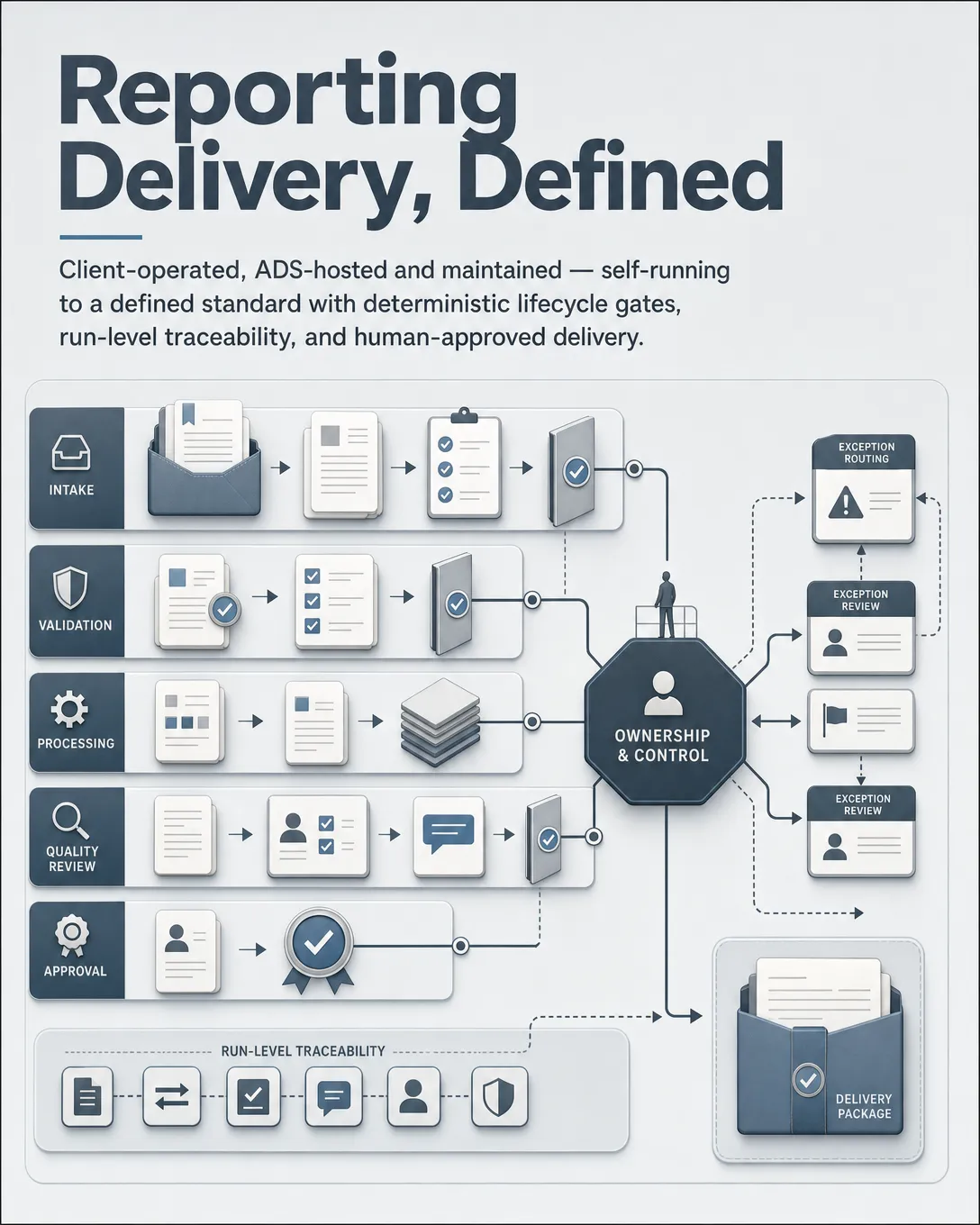
In this model, the system is client-operated and ADS-hosted and maintained. The configured workflow is self-running to a defined standard, but the client and its team retain control over approvals, exceptions, priorities, and day-to-day use.
A deterministic lifecycle governs intake, execution, approvals, escalation, and completion. For a reporting run, that lifecycle might establish:
1. Whether the request contains the required inputs and reporting period. 2. Which acceptance profile applies to that client or deliverable. 3. When analysis and draft creation can begin. 4. Which approval gate must be completed before publishing. 5. How missing inputs, metric conflicts, or late feedback are escalated. 6. What constitutes a completed run versus a completed client delivery.
This is where human-approved outputs become meaningful. Approval-gated execution ensures that a draft does not become an external deliverable simply because it exists. Clear approve/revise/reject steps give reviewers a defined way to respond, rather than forcing them to create process rules in the moment.
Run-level traceability records the state and outcome of each governed run. That makes it possible to distinguish an on-time completion from a delayed approval, an input exception, or a revision requested after review.
Build SLAs Around Conditions, Not Just Dates
Define when the delivery clock begins
A practical SLA should state the event that starts the clock. For example, reporting work may begin only after the client has provided named data sources, confirmed the reporting period, and supplied any required campaign, account, or stakeholder context.
This prevents teams from being held to a deadline based on an incomplete request. It also gives the Account Director a clear, client-facing explanation when delivery timing changes: the work is not delayed silently; it is waiting on a defined intake condition.
The contract should also distinguish between normal and exception paths. If a source is late, a metric definition changes, or a client requests a new reporting section, the workflow should record the exception and route it through the appropriate approval process.
Make acceptance criteria observable
Acceptance criteria should describe what reviewers can verify. They may include the required reporting period, named data sources, agreed metric definitions, mandatory sections, approved audience, presentation format, and required commentary on known exceptions.
For analysis, the criteria should also state how conflicting signals are handled. A report does not need to hide uncertainty to be acceptable. It needs to identify the source of the conflict, follow the agreed escalation rule, and avoid presenting unresolved assumptions as settled conclusions.
The strongest criteria separate quality review from preference changes. If a client requests a different narrative tone or additional segment after approving the defined scope, that may be a new request rather than a failure of the original run. Clear contract language protects both the client relationship and the reporting team.
Assign authority at each decision point
The Client Reporting Lead may own intake validation, standard review, and escalation of data questions. The Account Director may own client expectations, distribution confirmation, and decisions about client-facing exceptions. The client can retain final authority over external publication where appropriate.
The workflow supports those roles, but it does not erase them. A client-operated system gives the team the ability to use the configured process day to day, while human-approved outputs preserve accountability for what reaches the client.
Run-level traceability also supports more useful service conversations. Rather than debating whether reporting “felt late,” teams can review recorded workflow state and exceptions: when intake became complete, when a draft entered review, which approval was requested, and whether publication was approved or revised.
Make the Contract an Operating Agreement
An analytics delivery contract becomes more valuable when it is embedded in the reporting workflow instead of stored as a document no one consults during a live exception. Agentic Desk Solutions builds, hosts, maintains, and improves the operating platform, while the client team retains operational control and uses the client-operated system day to day. The system is ADS-hosted and maintained, governed by a deterministic lifecycle, and supported by run-level traceability so the client can apply its own acceptance standards with human-approved outputs. Book a consultation to map your highest-impact workflow.
Sources
- Gemini Enterprise Agent Platform release notes — https://docs.cloud.google.com/gemini-enterprise-agent-platform/release-notes
- Veo 3 | Gemini Enterprise Agent Platform | Google Cloud Documentation — https://docs.cloud.google.com/gemini-enterprise-agent-platform/models/veo/3-0-generate