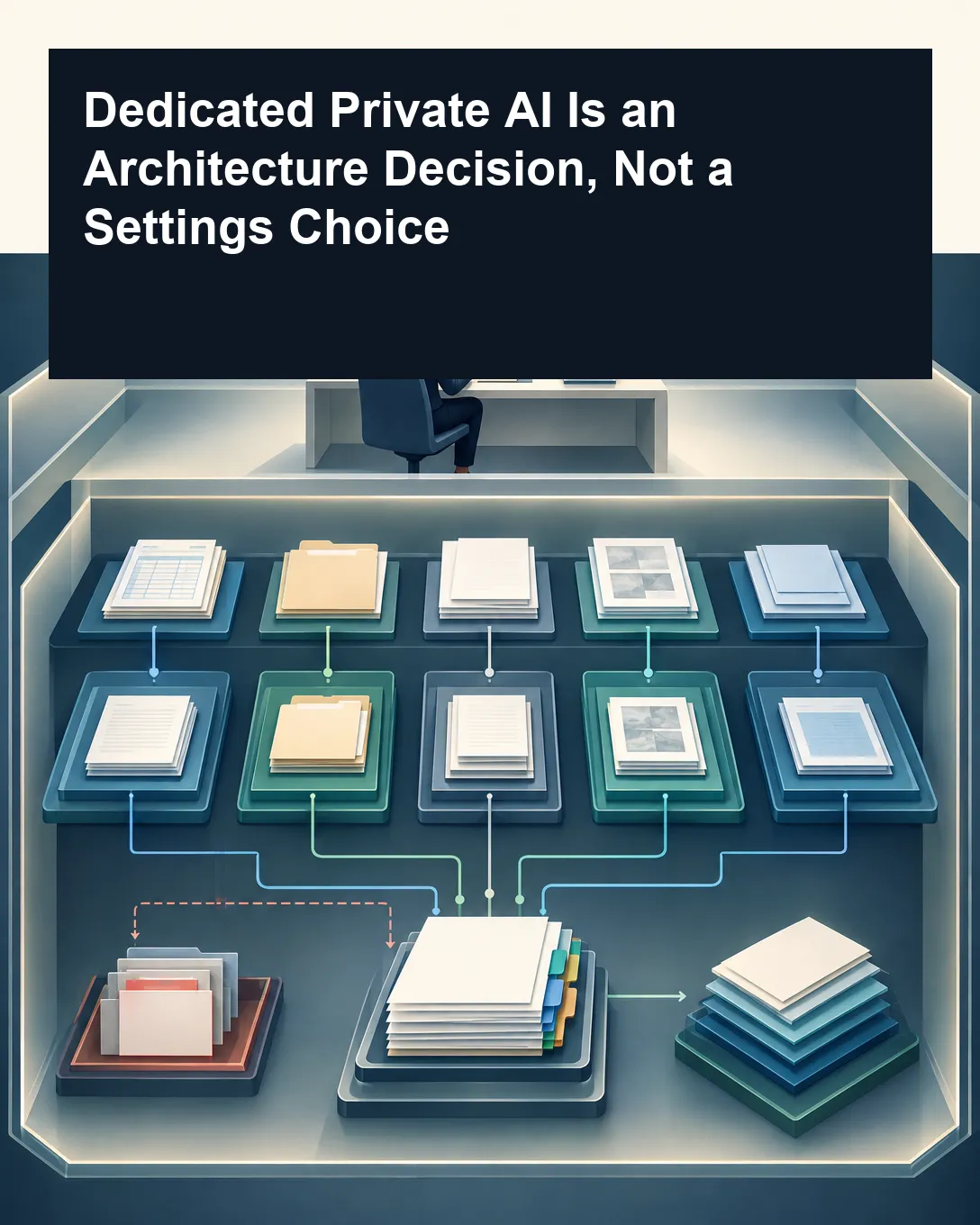
Dedicated Private AI Is an Architecture Decision, Not a Settings Choice
Confidential Work Creates a Decision Bottleneck
When confidential work arrives in uneven formats, the operational problem is not simply finding a place to ask questions. It is deciding where the work should happen, what information may enter the process, who can review the result, and how the team can revisit a conclusion later.
Consider an M&A firm principal preparing for a diligence meeting. The material may include financial statements, bank records, customer contracts, payroll files, and management explanations. The principal needs more than a summary. They need the numbers reconciled, exceptions identified, claims tied back to source material, and unanswered questions made visible before those questions become deal risk.
That is difficult to accomplish through an informal prompt-and-response process. The deliverable must become finished work that another person can inspect: a reviewable deliverable with source traceability, clear exceptions, and a defined approval point.
The same pressure applies to an accounting firm owner preparing recurring work for several sensitive engagements, or to a security reviewer assessing whether an internal process is handling confidential records appropriately. In each case, the central question is architectural: does the system keep the work inside a customer-specific process designed for the task, or does it send materials into a shared external service for analysis?
Why Shared AI Services Do Not Solve That Bottleneck
The common approach is to upload documents or paste sensitive information into a shared third-party AI service, then adjust available account or retention settings. Those settings may affect particular controls, but they do not answer the more fundamental question of where reasoning and analysis occur, how the workflow is bounded, or whether the final work can be reviewed as a structured record.
A shared service can create ambiguity around several practical matters:
- Which confidential files are appropriate to submit for a particular request
- Whether prompts, documents, and outputs follow the organization’s internal handling expectations
- How source references, assumptions, and exceptions are retained for review
- Who is authorized to approve a result before it is circulated
- How the team reconstructs what happened in a particular run
NIST’s AI Risk Management Framework Playbook emphasizes examining whether datasets contain sensitive or confidential information and documenting privacy risks. NIST’s Cybersecurity Framework 2.0 also points organizations toward AI risk resources as part of broader cybersecurity outcomes. The practical implication is straightforward: privacy review should include the workflow and system design, not just a preference selected in an account menu.
This is not an argument that one setting alone determines safety or that a dedicated design removes every risk. Access control, source handling, reviewer judgment, and operating discipline still matter. It is an argument that a settings choice cannot substitute for an architecture designed around confidential professional work.
Make Privacy an Architectural Choice
A dedicated private system establishes a different operating model. Rather than treating AI as a general-purpose destination for whatever a user happens to upload, it defines a bounded role, approved inputs, expected outputs, and business-specific approval boundaries.
Agentic Desk Solutions builds private AI employees that do bounded professional work inside a dedicated private system. The work is configured for your business: the records it should examine, the checks it should perform, the format it should produce, and the exceptions it must elevate.
Each customer receives a private system dedicated to that customer, deployed on-site or run from Agentic Desk Solutions infrastructure. Confidential customer data is not sent to a third-party AI provider for reasoning or analysis. That separation matters because it puts the work inside an environment designed around the customer’s workflow rather than a shared service designed for broad, open-ended use.
The system is not asked to act as an unbounded general assistant. It is assigned a defined professional job. For transaction and finance workflows, the Private AI Deal Team includes five bounded roles:
- Financial Records Accountant
- Forensic Accountant
- Diligence Investigator
- QoE Analyst
- Recast Engine
The Financial Records Accountant is also available as a standalone private AI employee for teams that need disciplined financial-records work without the broader deal-team configuration. Agentic Desk Solutions also builds custom private AI employees for other sensitive professional workflows where the role, inputs, and approval criteria can be clearly defined.
What the Architecture Changes in Practice
Define the work before files enter the process
A useful private system begins by stating what the role is expected to do and what it must not decide. For example, a Financial Records Accountant may organize and reconcile records, identify missing statements, flag discrepancies, and prepare a workpaper package. It should not invent support for a number that lacks documentation.
This bounded design produces finished, reviewable work rather than a collection of disconnected responses. If a statement is missing, a date range does not reconcile, or a classification cannot be established, the system names the unresolved item instead of guessing. That gives the human reviewer a specific question to resolve.
Keep a human reviewer above the system
A private AI employee does the assigned work, but a human reviewer remains above the system. Your team reviews the evidence, determines whether an exception has been resolved, and decides whether the output is acceptable for internal use or external delivery.
An approval gate creates a clear distinction between a drafted result and human-approved outputs. It also helps teams apply the right judgment to materiality, client context, and professional standards—areas that should not be reduced to an automatic conclusion.
Accepted results can be versioned for later review. Recorded workflow state and exceptions provide an auditable run history: what source materials were considered, what issues were identified, which approvals were logged, and what publish outcomes followed. That run-level traceability is particularly valuable for recurring work, where teams need consistency without losing visibility into each engagement’s facts.
Review evidence, not just conclusions
The output should be source-traceable work. A reviewer should be able to inspect the finished result, see the source support behind a finding, and understand the status of any open item. This makes review more practical than asking someone to reconstruct how a conclusion emerged from a long exchange.
For an M&A firm principal, that can mean receiving a reviewable package that separates reconciled figures, supporting records, anomalies, and diligence questions. For an accounting firm, it can mean recurring work that arrives in a consistent structure while preserving the professional reviewer’s authority over the accepted result.
Build the System Around Responsibility
Agentic Desk Solutions builds private AI employees and dedicated private systems for confidential professional work, including the Private AI Deal Team, the standalone Financial Records Accountant, and custom roles. Agentic Desk Solutions is responsible for building the bounded workflow, source-traceable work structure, and approval design; the client is responsible for defining authorized use, providing appropriate source materials, reviewing exceptions, and approving the final result. Book an AI Workforce Consultation.
Sources
- CISA, NSA and FBI Warn of China-Based AI Companies Targeting U.S. AI Models with Industrial-Scale Knowledge Distillation Campaigns — https://cisa.gov/news-events/news/cisa-nsa-and-fbi-warn-china-based-ai-companies-targeting-us-ai-models-industrial-scale-knowledge
- Measure — NIST AI Risk Management Framework Playbook — https://airc.nist.gov/airmf-resources/playbook/measure
- NIST Cybersecurity Framework 2.0: Informative References Quick-Start Guide — https://nvlpubs.nist.gov/nistpubs/SpecialPublications/NIST.SP.1347.pdf