Delegation Isn’t the Fix When a Role Keeps Breaking
The Real Operational Friction
Most operational stress doesn’t show up as one big failure. It shows up as a dozen small ones that keep returning no matter who you hand them to. A customer request gets “seen” but not answered. A renewal gets flagged but not followed through. An invoice is sent, but the supporting details aren’t attached. A lead is logged, but the handoff note is missing, so the next person asks the customer to repeat themselves.
You try to solve it the sensible way: delegate. You move the work to a coordinator, an assistant, a junior ops hire, or a rotating cast of “whoever has capacity this week.” For a few days it looks better. Then the same cracks reappear, just in different places. The work is being done, but the outcomes aren’t stable.
This is the kind of friction that makes owners feel like they’re managing the business *and* babysitting it. Not because the team is bad, but because the work itself hasn’t been treated like a role with operational ownership.
Why the Common Approach Fails
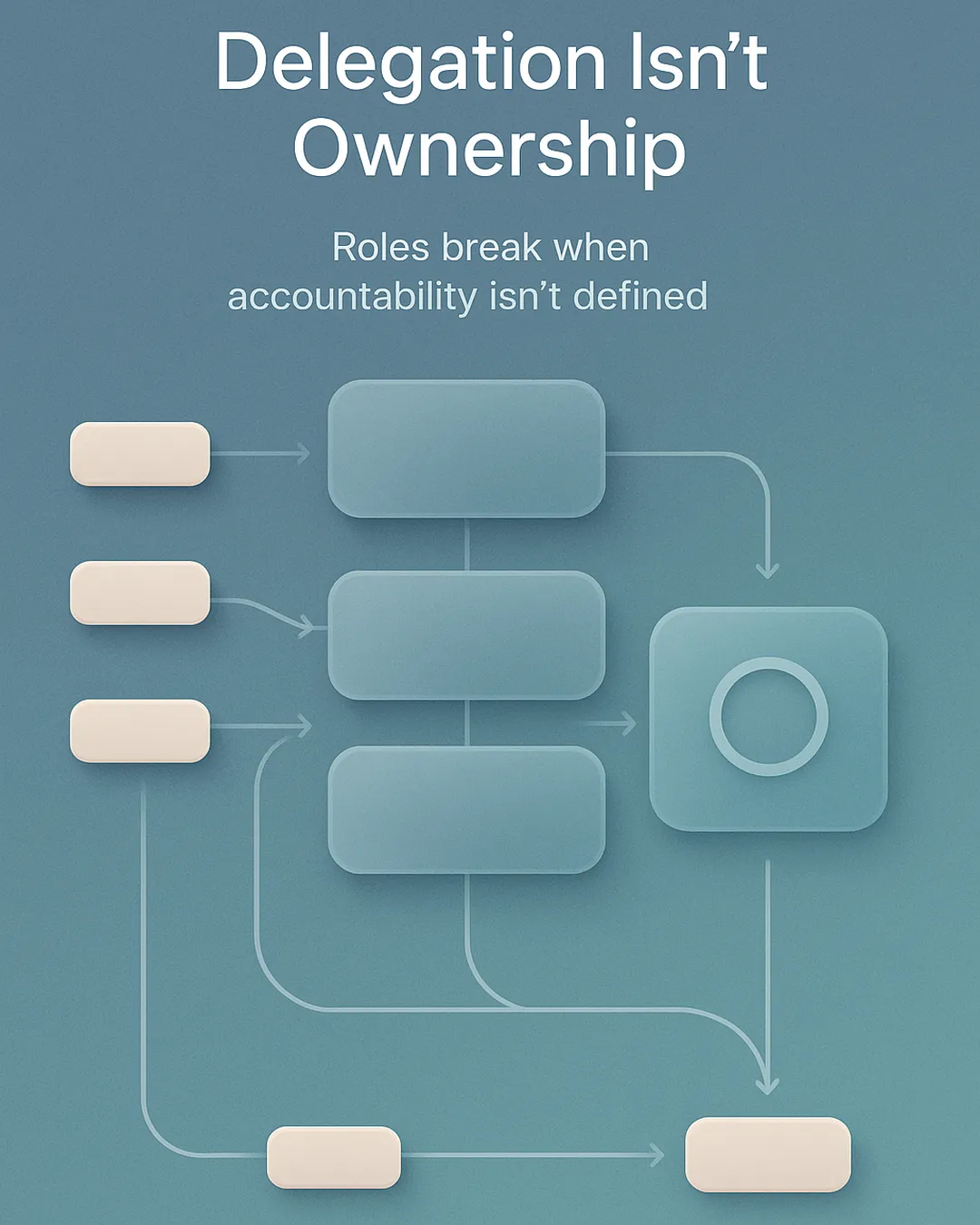
When something keeps slipping, the first instinct is usually to add people. If a task is late, assign it to someone else. If it’s unclear, add a manager. If nobody “owns it,” put it on the ops person’s plate. The problem is that delegation moves tasks, not responsibility. It changes *who touches it*, not *who is accountable for the outcome*.
Delegation fails in a few predictable ways:
Inconsistency. Different people handle the same situation differently. The customer gets different answers depending on who picked it up. The same exception is treated as urgent one week and ignored the next. That inconsistency isn’t a character flaw; it’s what happens when the work is task-based rather than role-based.
Drift. Even a conscientious employee drifts when the work is repetitive, interrupted, and not clearly measured. The checklist gets shortened. The “temporary” workaround becomes the new standard. The handoff message gets skipped because “it’s obvious.” Drift is natural when there aren’t defined responsibilities and a steady feedback loop.
Ownership ambiguity. When three people can do a thing, nobody owns it. When one person is “supporting” but another is “responsible,” escalation gets fuzzy. Work sits because everyone assumes someone else is on it. This is how you get polite internal chaos: no one is refusing to do the work, but no one can confidently say it’s handled.
No accountability. Without operational ownership, you can’t inspect outcomes. You can only inspect activity. You end up asking, “Did you follow up?” instead of seeing, “All follow-ups were completed within the agreed window, exceptions escalated, and outcomes logged.” Activity checks create more management overhead, which is the opposite of why you delegated in the first place.
Adding tools or layering automations often makes this worse. The work becomes distributed across inboxes, boards, and reminders, but it still lacks a single owner. You get more motion and more places for the process to break.
Reframe: Roles vs Tasks
The shift that changes everything is moving from task delegation to role definition. A task is “send the follow-up email.” A role is “Follow-up Owner,” with clear boundaries: what counts as a follow-up, what “done” means, what happens when the customer doesn’t respond, and when escalation occurs.
A role has four elements:
Defined responsibilities. Not just what to do, but what outcomes must be produced and recorded. Responsibilities include the edges: exceptions, incomplete information, and handoffs.
Operational ownership. One accountable owner for the role’s results. Not a committee, not “shared,” not “everyone keep an eye on it.” Ownership means a single point of accountability for consistency.
Escalation paths. The owner needs a clear route for cases they can’t resolve. Escalation is not failure; it’s part of the role. When escalation is defined, work doesn’t stall in ambiguity.
A stable loop. The role includes maintenance: keeping records current, closing loops, and ensuring the next step is triggered. This is where most delegated tasks quietly die—because “keeping it clean” is no one’s job.
Once you treat recurring work as a role, you can decide whether it should remain human-led, be restructured, or be handled by AI employees. That doesn’t mean sprinkling automation over tasks. It means considering replacing repeatable roles—roles where inputs are consistent, outcomes are definable, and exceptions can be escalated cleanly.
The point isn’t novelty. The point is stability. If the role can be made explicit—responsibilities, ownership, escalation—then it can be executed consistently. Humans can do that, but humans also drift. A role that breaks because it’s repetitive and interrupt-driven is often a candidate for replacement *once it’s defined as a role rather than a pile of tasks*.
Practical Implications
When a role is owned, several things improve immediately—even before you change who does the work.
First, exceptions become visible. Instead of “we’re dropping balls,” you see patterns: missing inputs, unclear handoffs, customers stalling at the same step, internal approvals taking too long. Visibility only happens when there’s operational ownership and a defined completion standard.
Second, handoffs stop being fragile. Most breakdowns happen between people, not within a person’s work. With defined responsibilities and escalation paths, handoffs are designed instead of improvised. The next step is triggered reliably, and the record of what happened is part of the role, not a nice-to-have.
Third, leaders get time back in a specific way. You stop answering “Where is this at?” questions all day. You stop being the default escalation path because the escalation path is explicit. You stop mediating internal ambiguity. Instead of managing reminders, you manage outcomes.
Fourth, replacing repeatable roles becomes realistic. Many owners think about replacing work and jump straight to tasks: “Can something send the email?” That’s rarely the real burden. The burden is *owning the follow-up loop*: deciding what to send, tracking responses, escalating edge cases, updating records, and ensuring nothing silently expires. When the role is defined, you can evaluate whether AI employees can take on that operational ownership with consistent execution and predictable escalation.
Finally, the business becomes calmer. Not because everyone works harder, but because fewer things are “nobody’s job.” Calm operations come from clear ownership, not heroic effort.
Agentic Desk Solutions helps operators identify where delegation is masking a missing role, then define the role with operational ownership, defined responsibilities, and escalation paths so it can run cleanly. In many cases, that clarity is what makes AI employees viable for replacing repeatable roles without creating new drift. “If you’re considering replacing a repeatable role, we can help you map it cleanly.”