From a Messy Data Room to a Reviewable Financial Recast
The friction begins before the financial analysis
For an M&A advisor, business broker, or deal team lead, a data room rarely arrives as a coherent financial record. It arrives as bank statements, accounting exports, payroll files, seller schedules, tax returns, PDFs with conflicting totals, and spreadsheets built for purposes other than diligence.
The challenge is not simply calculating adjusted EBITDA. Before that work can be trusted, the team must determine which documents govern, how periods align, whether account labels mean the same thing across files, and where evidence is incomplete. A financial recast can look polished while still resting on an untested mapping, an unsupported normalization, or an unexplained difference between the general ledger and a seller-provided schedule.
PwC’s financial due diligence overview reflects the breadth of this work: quality-of-earnings review often includes one-time item normalization, pro forma impacts, working capital, and cash-flow analysis. Each area depends on records that have been organized and defined before judgment is applied. Deloitte’s 2026 M&A trends research also notes growing AI use in screening and financial diligence, increasing the need to distinguish a quick output from work a reviewer can inspect.
Why the one-pass shortcut fails
The common shortcut is to place all available files into one general system and ask for a recast, an adjustment schedule, and a diligence summary in a single opaque model call. That approach collapses several professional responsibilities into one unchallengeable step.
A system can extract a number incorrectly, classify it as nonrecurring, carry it into adjusted EBITDA, and present the conclusion in a clean workbook. When extraction, investigation, judgment, and workbook construction are blended together, a reviewer may see the answer without seeing where the reasoning changed course.
That creates avoidable problems. A missing month may be treated as immaterial rather than named. A seller’s explanation may be treated as proof. A one-time expense may be normalized without enough counterevidence. A recast may include a correct formula applied to the wrong account definition.
The issue is not whether software can process records. The issue is whether the workflow preserves distinct handoffs so each conclusion can be examined. Finished, reviewable work requires those handoffs to remain visible.
A bounded private system for the deal workflow
Agentic Desk Solutions builds private AI employees that perform bounded professional work inside a dedicated private system. Each customer receives a dedicated private system deployed on-site or within infrastructure allocated by Agentic Desk Solutions. Confidential customer data is not sent to a third-party AI provider for reasoning or analysis.
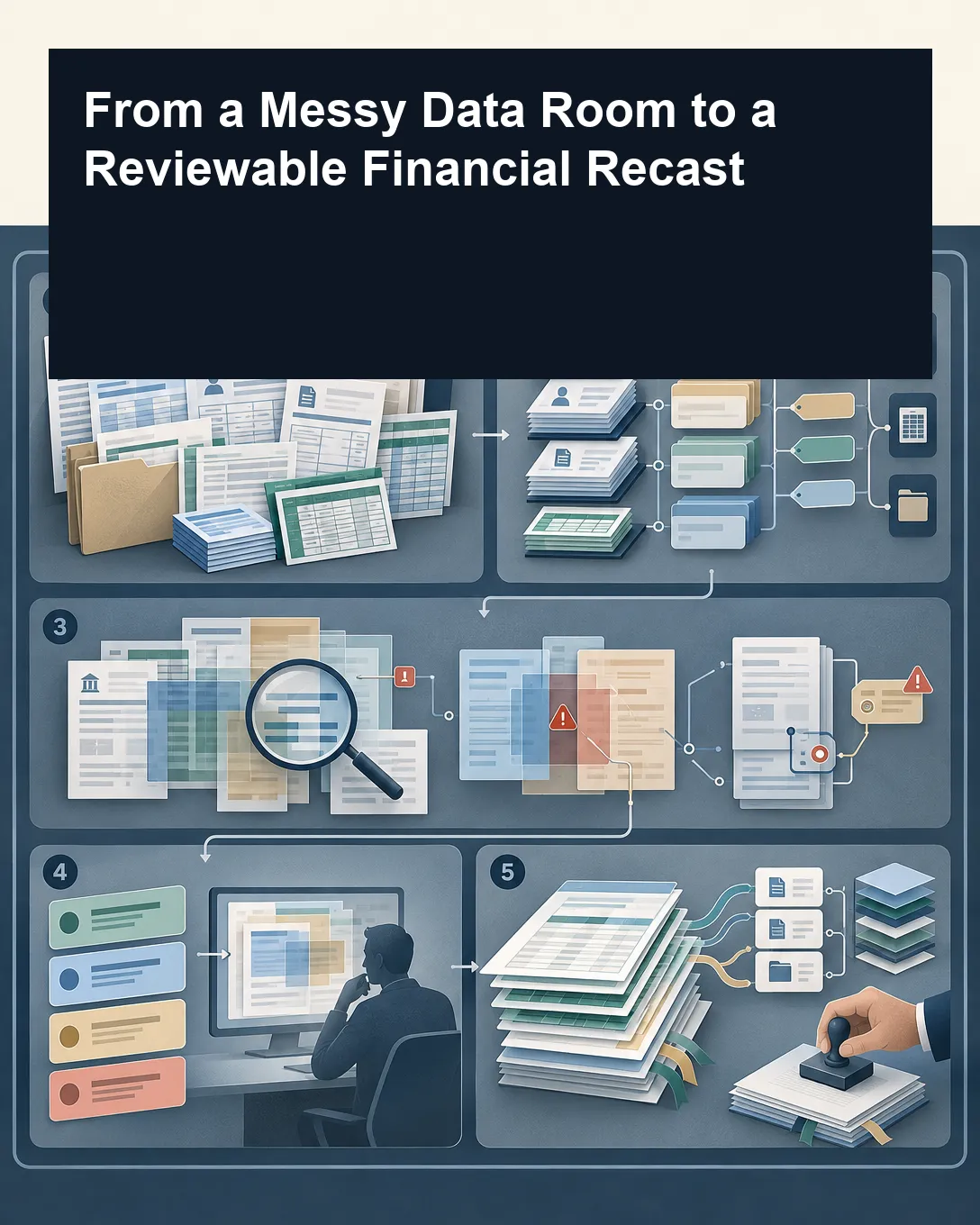
The flagship Private AI Deal Team separates the financial recast into five bounded roles rather than asking one process to do everything at once. This is checkpoint-based execution: each role has a defined responsibility, produces a reviewable handoff, and passes unresolved items forward instead of guessing.
Five roles, distinct responsibilities
The Financial Records Accountant organizes the incoming record set. It identifies files, periods, entities, accounts, and source relationships, then creates a consistent financial record foundation. This role is also available as a standalone private AI employee when a firm needs disciplined organization of financial records before broader diligence begins.
The Forensic Accountant tests the organized records for inconsistencies, unusual movements, missing support, and conflicts between source materials. It does not turn every anomaly into a conclusion; it names the issue and preserves the supporting evidence.
The Diligence Investigator follows those issues into the data room. It connects questions to documents, explanations, and counterevidence, making clear what has support and what remains unresolved.
The QoE Analyst applies professional judgment to earnings adjustments and recast treatment. This is where a prospective adjustment can be classified as supportable, unsupported, provisional, or dependent on a reviewer decision. The role keeps a distinction between a seller assertion and a conclusion grounded in the available record.
The Recast Engine constructs the workbook from the defined financial records and documented decisions. It produces schedules, mappings, and exception references without silently deciding questions that belong to investigation or QoE judgment.
Together, these private AI employees do the work rather than merely prepare suggestions. The point is not to remove judgment from a deal process. It is to ensure that judgment is applied at the right stage and remains traceable to source.
What the human reviewer receives
A useful financial recast should give the reviewer more than a final adjusted EBITDA number. It should provide a reviewable deliverable that includes the recast workbook, adjustment logic, source references, outstanding questions, and status of each material exception.
When a requested detail is absent, the system should state that it is absent. When evidence points in different directions, the conflict should be visible. When a treatment depends on a materiality decision or deal-specific context, it should be placed at an approval gate rather than buried in a formula.
This is where end-to-end workflow automation has practical value. The workflow can move records from intake through organization, investigation, judgment, and workbook assembly, while retaining human review at the decisions that require it. The resulting work is human-approved, not presented as an unexamined answer.
A human reviewer remains above the system. Your team reviews the financial treatment, resolves named exceptions, and accepts or returns work at defined checkpoints. Accepted results are versioned for later review, with run-level traceability, logged approval and publish outcomes, and an auditable run history of recorded workflow state and exceptions.
That changes the reviewer’s task. Instead of reconstructing how a finished workbook was assembled, the reviewer can focus on what matters: whether the sources are sufficient, whether the adjustment is reasonable, and whether the deal context changes the conclusion.
Build recast work your team can review
Agentic Desk Solutions builds the Private AI Deal Team and custom private AI employees for sensitive professional workflows. Agentic Desk Solutions is responsible for building and deploying the bounded system that produces source-traceable, finished, reviewable work; the client is responsible for providing authorized records, setting deal context and materiality, resolving named questions, and having a human reviewer approve outputs. Book an AI Workforce Consultation.
Sources
- Financial due diligence: PwC — https://pwc.com/us/en/services/consulting/deals/joint-ventures-alliances/financial-due-diligence.html
- Trusted Valuation Services for Business Brokers: BizWorth — https://ibba.org/resource-center/supplier-directory/bizworth
- 2026 M&A Trends Pulse Survey — https://deloitte.com/us/en/what-we-do/capabilities/mergers-acquisitions/articles/m-a-trends-report.html