When a Standalone Financial Records Accountant Is the Right First AI Employee
The friction behind financial-records work
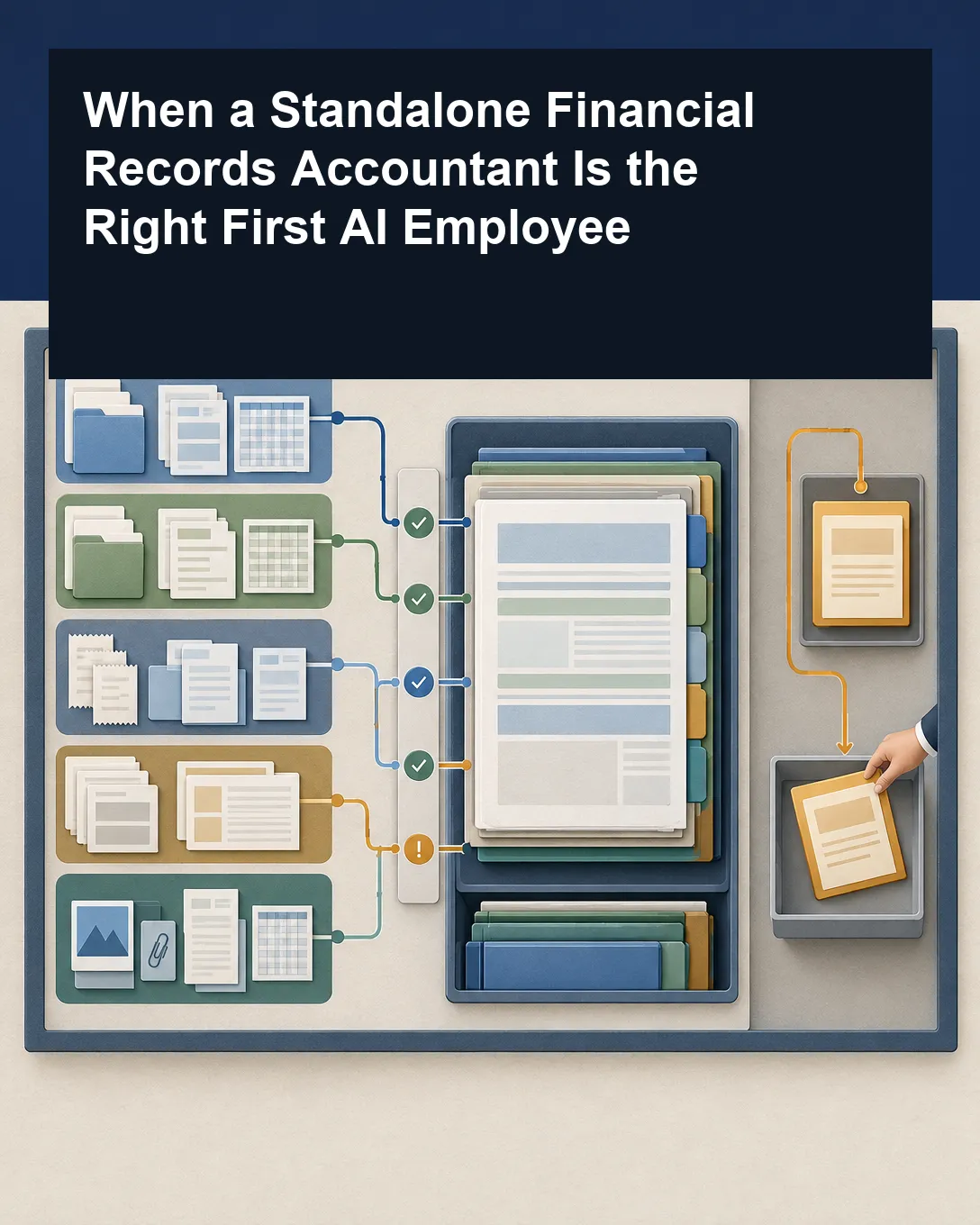
Financial-records work often creates a bottleneck long before an accounting firm owner, advisory principal, or fractional CFO reaches the analysis that clients value most. Source documents arrive through scattered channels: bank records, general-ledger exports, invoices, payroll reports, debt statements, spreadsheets, and email attachments. Before anyone can assess the numbers, someone must organize the materials, identify what is missing, and prepare the record set for review.
This work is repetitive, but it is not low-stakes. A document filed under the wrong period, an unexplained variance, or a missing support item can affect downstream analysis and delay a client deliverable. Teams often compensate by assigning experienced people to chase files, standardize records, and answer the same status questions each cycle.
That makes financial-record organization a strong candidate for a first private AI employee when the workflow has clear boundaries. The question is not whether every accounting decision can be standardized. It is whether one defined job can consistently turn a known set of source materials into a finished, reviewable work product for a human reviewer.
Signals that the role is bounded enough
A standalone Financial Records Accountant is usually a practical starting point when:
- The same categories of financial records arrive repeatedly for a period, engagement, or transaction.
- The expected result is clear: organized records, identified gaps, exception items, and material prepared for review.
- The firm has rules for handling missing, conflicting, or unreadable information.
- A designated human reviewer can assess the result against a known checklist.
- The work recurs often enough that consistent execution matters.
It may not be the right first deployment when the work depends mainly on undocumented business context, negotiation, or judgment that has no stable review standard. In those cases, the process should be clarified before it is assigned to a bounded role.
Why the common approach falls short
Many firms address the problem with a mix of manual staff effort, shared folders, email follow-ups, and ad hoc use of general AI systems. That can create snippets of assistance, but it does not establish a reliable process for moving from source records to a reviewable deliverable.
The reviewer still has to determine which files were used, what was omitted, whether an item was inferred, and how the work progressed. When the same task is handled differently each month or by a different person on each engagement, the resulting work is difficult to compare and hard to improve.
Sensitive financial records also require a more deliberate approach than sending documents to an outside AI provider for reasoning or analysis. The issue is not simply file access. It is the need for a controlled system, known boundaries, and documented handling of exceptions.
A standalone Financial Records Accountant solves a different problem than a drafting assistant. It is designed around a defined professional responsibility: organize the records, produce the required work, identify what cannot be resolved, and present the result for human review.
Reframe records organization as an approved system
The right first AI employee is not a loose layer added to an existing process. It is a bounded role operating inside a dedicated private system.
Agentic Desk Solutions builds private AI employees that do the work, not merely assist with it. The standalone Financial Records Accountant is designed around an agreed scope of inputs, outputs, exception rules, and review criteria. Within that scope, it supports end-to-end workflow automation through checkpoint-based execution rather than a single opaque response.
The work product should be finished, reviewable, source-traceable work. A reviewer should be able to see the relevant source material behind the result, assess the named exceptions, and approve or return the work through an approval gate. When records are absent, inconsistent, or insufficient, the system names the unresolved item instead of guessing.
Each customer receives a dedicated private system, deployed on-site or within private infrastructure provided by Agentic Desk Solutions. Confidential customer data is not sent to an outside AI provider for reasoning or analysis.
Human review remains above the system. Human-approved outputs are versioned for later review, while recorded workflow state, exceptions, logged approvals, and publish outcomes provide an auditable run history. This keeps the professional responsible for judgment while making the underlying records workflow more consistent.
What the first deployment changes
For a firm owner, the practical benefit is not a claim that professional judgment disappears. It is a clearer separation between repeatable records work and the higher-value review, advisory, and decision work that depends on it.
A Financial Records Accountant can provide a disciplined starting point for recurring work because it forces the firm to define what “complete” means. Which records belong in the packet? What should be flagged? What can be accepted without escalation? Who performs human review? Those questions improve the process whether the role is deployed for a single recurring engagement type or expanded across the firm.
The standalone role can also become the first component of a broader Private AI Deal Team. That team includes five bounded roles: Financial Records Accountant, Forensic Accountant, Diligence Investigator, QoE Analyst, and Recast Engine. Firms can begin with the records workflow that is most repeatable, then add roles only where responsibilities, source materials, and review standards are equally clear.
For sensitive professional workflows that do not match these roles, Agentic Desk Solutions also builds custom private AI employees. The principle remains the same: define the work, keep it in a dedicated private system, make the result reviewable, and retain a human reviewer with responsibility for approval.
A defined responsibility with Agentic Desk Solutions
Agentic Desk Solutions is responsible for building the private AI employee, configuring its bounded workflow, and providing the dedicated private system for the approved scope. The client is responsible for defining the engagement requirements, supplying authorized source records, and assigning the human reviewer who evaluates exceptions and approves the finished result. For accounting and advisory firms whose records work is repeatable, sensitive, and ready for consistent review, a standalone Financial Records Accountant can be the right first step. Book an AI Workforce Consultation.