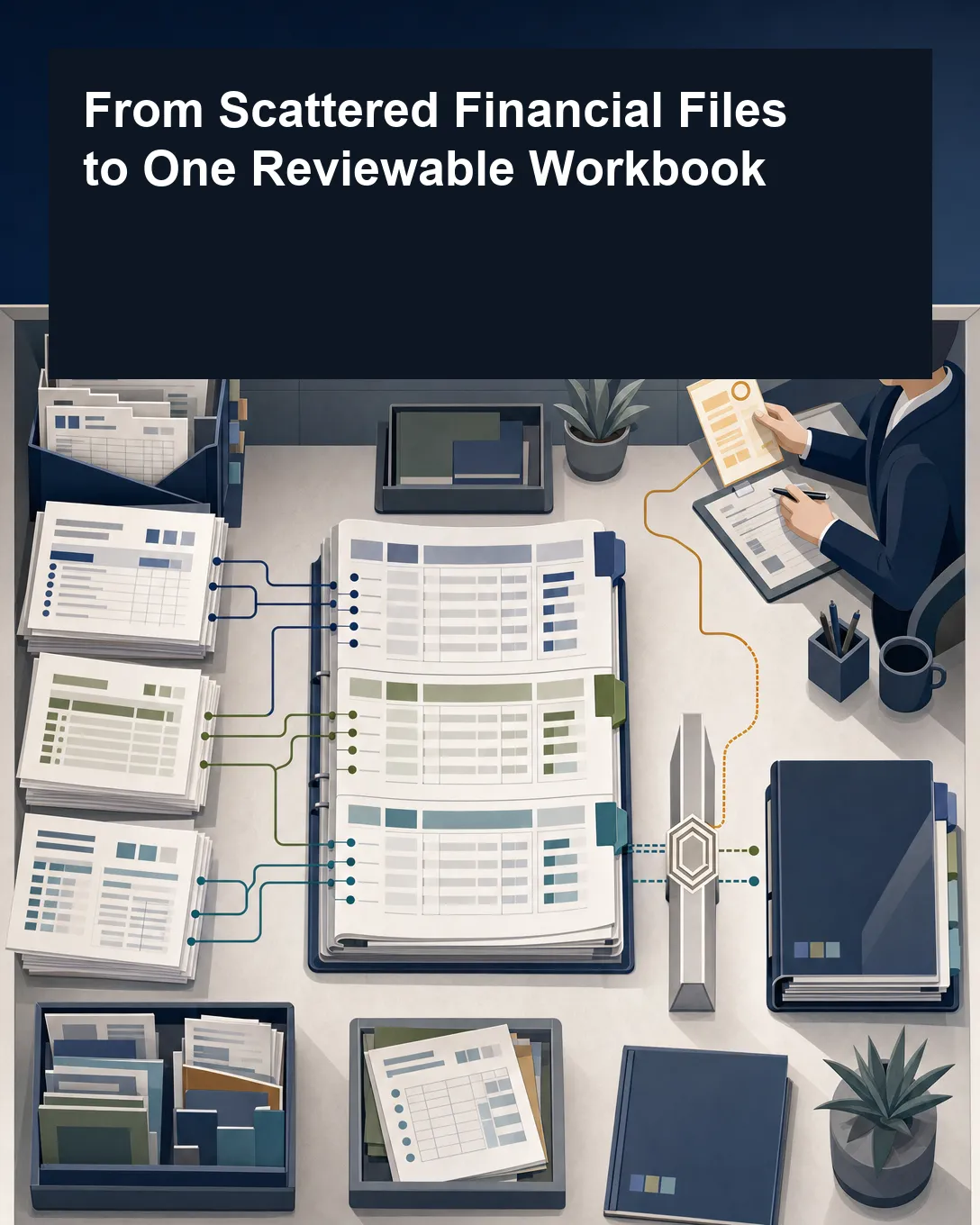
From Scattered Financial Files to One Reviewable Workbook
Financial records rarely arrive ready for review
Financial review often begins with a collection of files rather than a coherent working package. Bank statements may arrive as PDFs, general ledgers as exports, operating schedules as spreadsheets, and supporting reports as downloads from separate systems. An accountant, advisor, or business owner may have the necessary records, yet still lack a workbook that can be reviewed, questioned, and approved.
The friction is more than file collection. Dates can follow different conventions. Account names may vary between a ledger and a spreadsheet. A worksheet may contain an adjustment without documentation, while a transaction export may omit details that appear on the corresponding statement. Records can cover slightly different periods or contain balances that need explanation before they can be used in a review.
Without a structured process, preparation becomes repeated searching. Someone finds a balance in one document, looks for support in another, enters it into a workbook, and leaves a note for an exception. Later, a reviewer asks where that figure came from. The team then has to locate the relevant statement page, ledger line, export record, or spreadsheet tab again.
This approach slows the review and makes it dependent on the person who assembled the file. It can also allow unresolved questions to disappear into a summary instead of remaining visible for a decision.
A cleaner workbook is not necessarily reviewable work
The common response is manual consolidation: place the files in a folder, copy key figures into a spreadsheet, and prepare a summary. That may create a more orderly document, but it does not necessarily produce reviewable work.
A reported amount needs a visible path back to its support. When source references are lost during copying, a reviewer cannot readily see whether a figure came from a statement page, a ledger entry, a formula, or an adjustment entered in a separate worksheet. A discrepancy may be given a vague label or carried forward without clear ownership.
The problem compounds during recurring work. Each reporting cycle can become another rebuilding exercise: recreate folders, repeat formulas, recheck classifications, and reconstruct prior questions. Even when the workbook looks familiar, it may be difficult to determine what changed, why it changed, and whether an earlier exception was resolved.
The issue is not the capability of the people involved. The work needs to be treated as a bounded professional process with defined inputs, a specified deliverable, named exceptions, and an approval gate.
Reframe consolidation as a structured financial-records process
The Financial Records Accountant is a standalone private AI employee from Agentic Desk Solutions designed to do this bounded work. It organizes supplied bank statements, ledgers, spreadsheets, and exports into a structured workbook that supports human review.
The intended result is finished reviewable work rather than a general summary. Source records are indexed and organized before they are used in schedules, reconciliations, and workbook summaries. A reviewer can follow a figure to its supporting record through references such as file names, statement pages, ledger lines, worksheet locations, or export entries.
This source-traceable approach also gives uncertainty a defined place. If a transaction cannot be confidently reconciled, a period is missing, a classification lacks sufficient support, or an adjustment needs explanation, the system names the unresolved item rather than guessing. The exception remains visible for the human reviewer who has the authority to decide how it should be handled.
Checkpoint-based execution supports this sequence. Records can first be gathered and indexed, then standardized into a consistent structure, then organized into schedules and tested for exceptions before the workbook reaches review. A human reviewer remains above the system through the approval gate, with human-approved outputs serving as the basis for accepted results.
Agentic Desk Solutions builds private AI employees that do the work inside a dedicated private system. Each customer receives a dedicated private system that can be deployed on-site or run by Agentic Desk Solutions. Confidential customer data is not sent to a third-party AI provider for reasoning or analysis.
The system also preserves recorded workflow state and exceptions, along with logged approval and publish outcomes. That creates run-level traceability and an auditable run history for later review. Accepted results are versioned so the team can revisit what was approved at a given point and understand the context around later changes.
What a structured workbook changes for reviewers
For an accountant, the practical change is less time spent reconstructing the support behind a reported balance. The workbook becomes a working review file with schedules, references, reconciliation points, and a visible exception list instead of a presentation assembled after the analysis is complete.
For an advisor, source traceability makes follow-up more precise. Rather than asking broad questions about a change in a schedule, the advisor can focus on the identified issue: a transaction without ledger support, an unsupported adjustment, a missing source period, or a classification requiring a decision.
For a business owner, the deliverable provides clearer accountability. The output is not an informal file collection or a message about possible concerns. It is a reviewable deliverable that shows the relevant inputs, organized findings, and unresolved items that need attention from the responsible people.
The process is also useful for recurring work. A consistent financial-records workflow reduces the need to reconstruct the same preparation steps each cycle while retaining human judgment where it belongs. Versioned, human-approved outputs provide a record of what the team accepted and which exceptions remained open at that time.
The Financial Records Accountant is also one of five bounded roles in the Private AI Deal Team, alongside the Forensic Accountant, Diligence Investigator, QoE Analyst, and Recast Engine. Each role is directed toward a distinct class of finished, reviewable, source-traceable work.
Put human review at the center of the workbook
Agentic Desk Solutions builds private AI employees for sensitive professional workflows, including the Financial Records Accountant for financial-record organization and workbook preparation. Agentic Desk Solutions is responsible for building the dedicated private system, structuring the bounded workflow, and producing finished, reviewable, source-traceable work with unresolved items clearly named. Your team is responsible for providing the relevant records, reviewing exceptions, applying professional judgment, and approving the final deliverable. Book an AI Workforce Consultation.