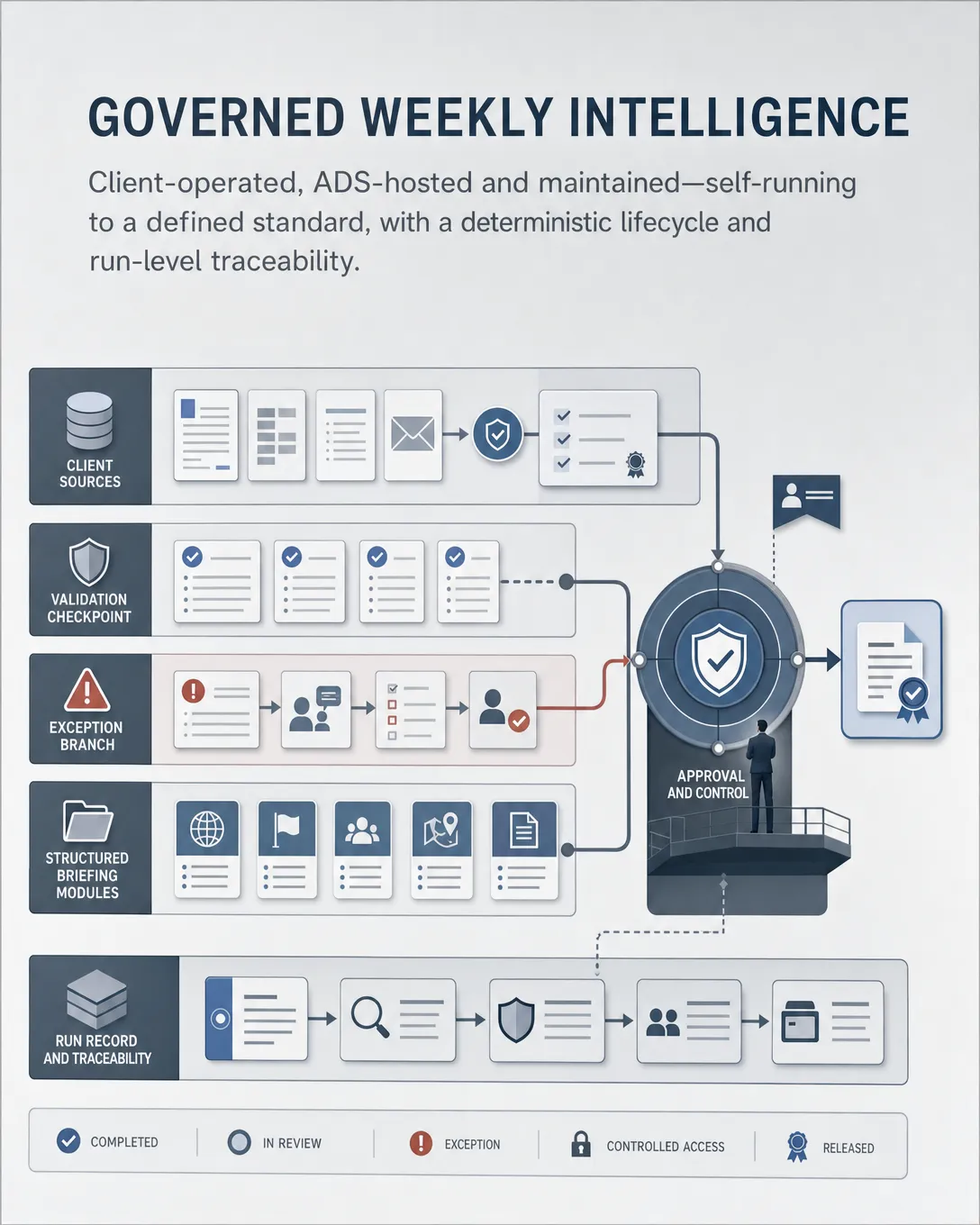
From Client Data to Operator-Ready Intelligence Without Narrative Drift
The operational friction behind weekly client reporting
Most client teams do not lack data. They lack a reliable way to turn that data into operator-ready intelligence before the next decision is due.
An Operations Analyst may pull pipeline figures from a CRM, financial performance from a billing system, delivery data from project records, and account signals from support activity. The Managing Director then needs a clear view of what changed, what requires attention, and what decision should follow. Too often, that handoff arrives as a polished narrative with unclear assumptions behind it.
Narrative drift begins when the data-to-decision path is informal. A temporary decline in conversion can become a broad statement about demand. A delayed invoice may be presented as a retention issue. A metric may be compared with the wrong period, filtered differently from the prior week, or calculated from an incomplete export. The wording sounds confident, but the operating context is missing.
Public updates to AI capabilities are a reminder that technology changes quickly. Yet a new capability does not resolve a process where source definitions, review ownership, and publish criteria remain unclear. The core issue is not whether a system can write a summary. It is whether the organization can trust how that summary was assembled, reviewed, and released.
For recurring work, clients need more than a weekly recap. They need a governed workflow that translates known numbers into decision-ready analysis without allowing unsupported conclusions to enter the reporting cycle.
Why the common summary-first approach fails
The common approach starts with prose. A team gathers exports, asks an AI automation layer for a weekly update, then edits the output until it appears presentable. This can save drafting time, but it leaves several operational gaps.
First, the logic behind the numbers is often not explicit. Which sources are authoritative? What reporting period applies? Which records are excluded? What happens when a source is unavailable or a threshold is breached? Without predefined answers, each weekly run can become a fresh interpretation exercise.
Second, fluent language can make provisional observations appear settled. A summary may describe an increase, decline, risk, or opportunity without preserving the underlying comparison, exception, or calculation rule. The reader receives a conclusion but cannot easily assess its basis.
Third, an emailed document does not create a reliable approval process. If someone revises a recommendation, changes a data point, or holds publication because an input is incomplete, that state needs to be visible. Otherwise, the team cannot distinguish between work that is pending, approved, escalated, or complete.
The result is reporting that may look finished but remains difficult to operate. It depends on memory, individual judgment, and last-minute clarification rather than a repeatable path from intake to human-approved outputs.
Reframe analysis as a governed operating system
A better model treats analysis as a custom AI operations system configured for your business, not as a one-off writing exercise. The aim is to make the evidence, workflow state, and approval responsibilities visible before a narrative reaches decision-makers.
A deterministic lifecycle can govern the process from intake through completion. At intake, the workflow identifies the approved data sources, reporting window, expected files, and metric definitions. During execution, it applies the agreed calculations and flags missing records, data conflicts, or threshold exceptions. The analysis stage turns validated observations into a structured briefing with the required context and decision prompts.
An approval gate then places operating authority with the client team. A reviewer can approve, return, or escalate the briefing before publication. This supports human-approved outputs rather than treating generated text as a final deliverable by default.
The important evidence is not simply that a briefing exists. It is that the workflow provides consistent workflow status changes and clear scheduled and approval states. The Operations Analyst can see whether data collection is complete, whether an exception needs review, and whether the report is ready to publish. The Managing Director can see what is awaiting a decision rather than reconstructing the process from messages.
Run-level traceability records the state and outcome of each governed run. That can include the reporting period, input status, exceptions raised, assigned reviewer, logged approval and publish outcomes, and any required follow-up. An auditable run history makes it easier to investigate a changed number or a delayed report without relying on recollection.
Practical implications for client teams
Make every metric answer a defined question
Weekly intelligence should answer operating questions, not merely list activity. For example: Which client accounts need intervention? Which delivery constraint is affecting margin? Which pipeline movement requires a leadership decision? Which exceptions are outside the agreed threshold?
Each question should connect to a defined source, calculation rule, expected owner, and escalation route. This prevents a report from becoming a collection of interesting but unprioritized numbers.
Give each role a clear handoff
The Operations Analyst may validate inputs, investigate flagged exceptions, and prepare context for review. The Managing Director may approve a priority, choose an action, or assign follow-up responsibility. These roles do not need the same view of the workflow, but both need access to the information appropriate to their authority.
This approach keeps the system client-operated. The client and its team use it day to day, retain decision rights, and determine when an item should move forward. The configured workflow can be self-running to a defined standard while still routing material exceptions and publication decisions through the right people.
Improve the process without losing the record
Over time, teams can refine thresholds, add approved sources, adjust briefing formats, and improve escalation logic. Those changes should strengthen the operating system without obscuring what happened in earlier runs.
That matters when client data is used for weekly reporting, operational planning, and leadership decisions. A system that preserves recorded workflow state and exceptions can support improvement while retaining a clear account of how prior outputs were produced.
Build a dependable analysis workflow with Agentic Desk Solutions
Agentic Desk Solutions builds, hosts, maintains, and improves the operating platform while the client retains operational control. The configured system is client-operated and ADS-hosted and maintained, with the client team setting priorities, reviewing exceptions, and approving outputs. Agentic Desk Solutions can configure recurring work end-to-end around the tools you already use, a deterministic lifecycle, and run-level traceability so weekly intelligence remains useful without narrative drift. Book a consultation to map your highest-impact workflow.
Sources
- ChatGPT Enterprise & Edu - Release Notes | OpenAI Help Center — https://help.openai.com/en/articles/10128477-chatgpt-enterprise-edu-release-notes
- ChatGPT — Release Notes | OpenAI Help Center — https://help.openai.com/en/articles/6825453-chatgpt-release-notes
- OpenAI News | OpenAI — https://openai.com/news
- OpenAI Newsroom | Recent news | OpenAI — https://openai.com/news/company-announcements