Where a Private AI Employee Should Run
The deployment question starts with daily friction
A firm can agree that sensitive professional work needs a private AI employee and still face a practical question: where should it run?
For a firm owner, the issue may be control over confidential records and professional judgment. For an IT lead, it may be identity controls, infrastructure access, and maintenance duties. For a compliance reviewer, it may be whether each result can be reviewed, traced to source, approved, and revisited later.
These concerns become immediate when work involves financial files, diligence materials, client records, or recurring reporting. The deployment location affects who can submit records, who can access the system, who maintains the environment, and how the human reviewer receives finished work.
KPMG reported in its September 2026 AI Pulse Survey that 72% of organizations formally consider model sovereignty, including where AI models, data, and intellectual property are controlled and governed. For sensitive work, this is not simply an infrastructure preference. It is an accountability decision.
Why a general service does not solve the problem
A common approach is to connect a broad online service to a growing collection of documents and assume permissions will resolve the risks. That can leave important questions unanswered: Who is authorized to submit work? Which records may be processed? What professional task is in scope? Who decides whether a result is ready for use?
Permissions do not by themselves create a reviewable process. A result may appear complete while leaving the reviewer to reconstruct its sources, test its assumptions, or discover that conflicting evidence was never identified. That is not finished reviewable work.
Sensitive workflows need defined work boundaries, an approval gate, and a clear record of exceptions. When evidence is missing, conflicting, or outside the assigned scope, the system should name the unresolved item rather than guess. A human reviewer remains above the system, responsible for applying professional judgment before a result is accepted.
Start with the approved system, not just the location
The useful choice is not whether customer-site infrastructure is always preferable to Agentic Desk Solutions infrastructure. It is whether the environment supports the work your firm has approved.
Agentic Desk Solutions builds private AI employees that perform bounded professional work inside a dedicated private system. These systems do the work, rather than merely assisting with it, and produce finished reviewable work for a designated reviewer. The result is source-traceable, with unresolved items identified clearly instead of filled with unsupported conclusions.
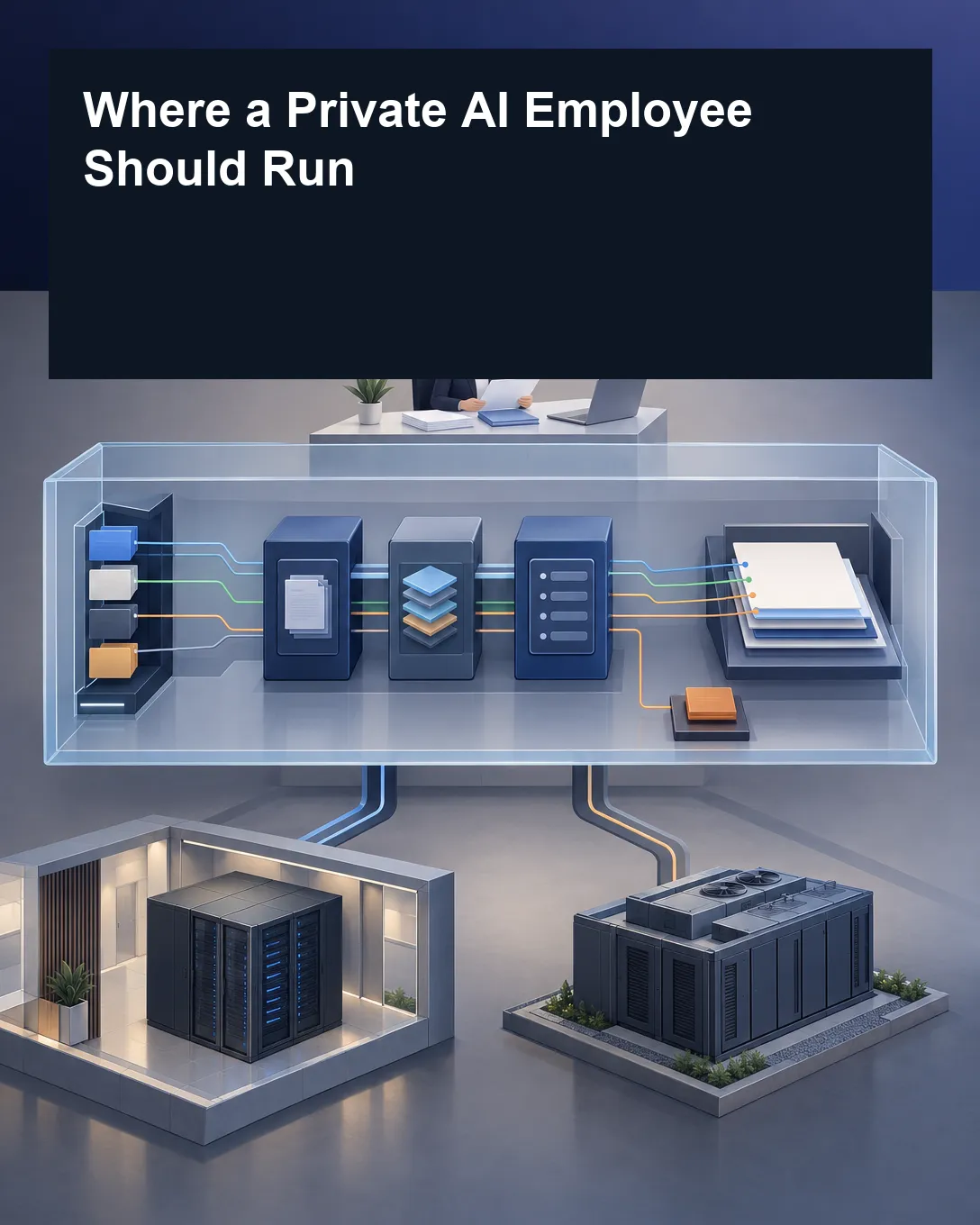
Each customer receives a dedicated private system. It can be deployed on-site or run in infrastructure maintained by Agentic Desk Solutions. In either arrangement, confidential customer data is not sent to a third-party AI provider for reasoning or analysis.
The work can be configured for your business, with business-specific approval boundaries that define access, task scope, exception conditions, and the people permitted to approve results. Human-approved outputs can be retained with run-level traceability, auditable run history, and logged approval and publish outcomes. Accepted results are versioned for later review.
When customer-site infrastructure fits
An on-site deployment can fit when a firm needs processing to remain within its own facility or already has a customer-dedicated server and internal controls suited to sensitive workflows.
In this arrangement, the customer’s IT lead is responsible for the agreed facility, server capacity, internal network access, and infrastructure maintenance. The firm should determine who authorizes changes, who maintains access records, and how approved personnel reach the dedicated private system.
On-site deployment does not remove review duties. The compliance reviewer still needs source traceability, named exceptions, and reviewable work that makes clear which records support the result. The location changes infrastructure responsibilities; it does not remove the human review requirement.
When Agentic Desk Solutions infrastructure fits
The Agentic Desk Solutions infrastructure option can fit when a firm wants a dedicated private system without assuming responsibility for the underlying servers and environment.
Agentic Desk Solutions maintains that environment, while the customer remains responsible for authorized users, permitted records, professional review, and approval decisions. This can suit recurring work when the customer needs consistent access and a defined review path without adding internal server duties.
The firm owner, IT lead, and compliance reviewer should still agree on access rules, work boundaries, escalation conditions, and the review desk process. A different deployment location should not blur who is accountable for the final professional decision.
What the choice changes in practice
Access and maintenance responsibilities
The firm should define who can submit records, view work in progress, review the finished deliverable, and approve publication or use. Access should follow the work boundary, not simply a person’s job title.
Maintenance duties should also be explicit. For an on-site system, the customer handles the agreed infrastructure and internal access environment. For a system running in Agentic Desk Solutions infrastructure, Agentic Desk Solutions maintains the dedicated private system environment. In both cases, the customer controls decisions about its records, authorized people, and approval requirements.
Review and exception responsibilities
A human reviewer needs more than a plausible-looking response. The reviewer should be able to see what the private AI employee was asked to do, which sources were used, what was completed, and what could not be resolved.
Recorded workflow state and exceptions make that possible. If records conflict, evidence is absent, or a request crosses an approval boundary, the system should identify the issue for the appropriate person to decide. This creates a reviewable result rather than an unsupported conclusion.
Selecting the right bounded role
The deployment decision should support the work itself. Agentic Desk Solutions’ Private AI Deal Team includes five bounded roles: Financial Records Accountant, Forensic Accountant, Diligence Investigator, QoE Analyst, and Recast Engine.
The Financial Records Accountant is also available as a standalone private AI employee. Agentic Desk Solutions also builds custom private AI employees for sensitive professional workflows that need their own defined scope, source requirements, and human review path.
A deployment choice with accountable review
Agentic Desk Solutions builds the private AI employees and dedicated private system. For a system running in Agentic Desk Solutions infrastructure, Agentic Desk Solutions maintains the environment; for an on-site deployment, the customer is responsible for the agreed facility, infrastructure, internal access, and local policies. In either model, the customer determines authorized records and users, while its human reviewer approves professional results before use. The goal is finished, reviewable, source-traceable work with named exceptions and documented decisions. Book an AI Workforce Consultation.
Sources
- New KPMG AI Pulse Survey: As AI maturity converges, leading organizations show what AI at scale requires — https://kpmg.com/xx/en/media/press-releases/2026/09/new-kpmg-ai-pulse-survey-as-ai-maturity-converges-leading-organizations-show-what-ai-at-scale-requires.html
- How should leaders govern AI systems they cannot fully control? — https://kpmg.com/us/en/media/blogs/2026/how-should-leaders-govern-ai-systems-they-cannot-fully-control.html
- Trustworthy AI | Deloitte UK — https://deloitte.com/uk/en/services/risk-advisory/services/trustworthy-ai.html
- Comments on Software and Agentic AI Identity Concept Paper — https://nccoe.nist.gov/news-insights/comments-software-and-agentic-si-identity-concept-paper