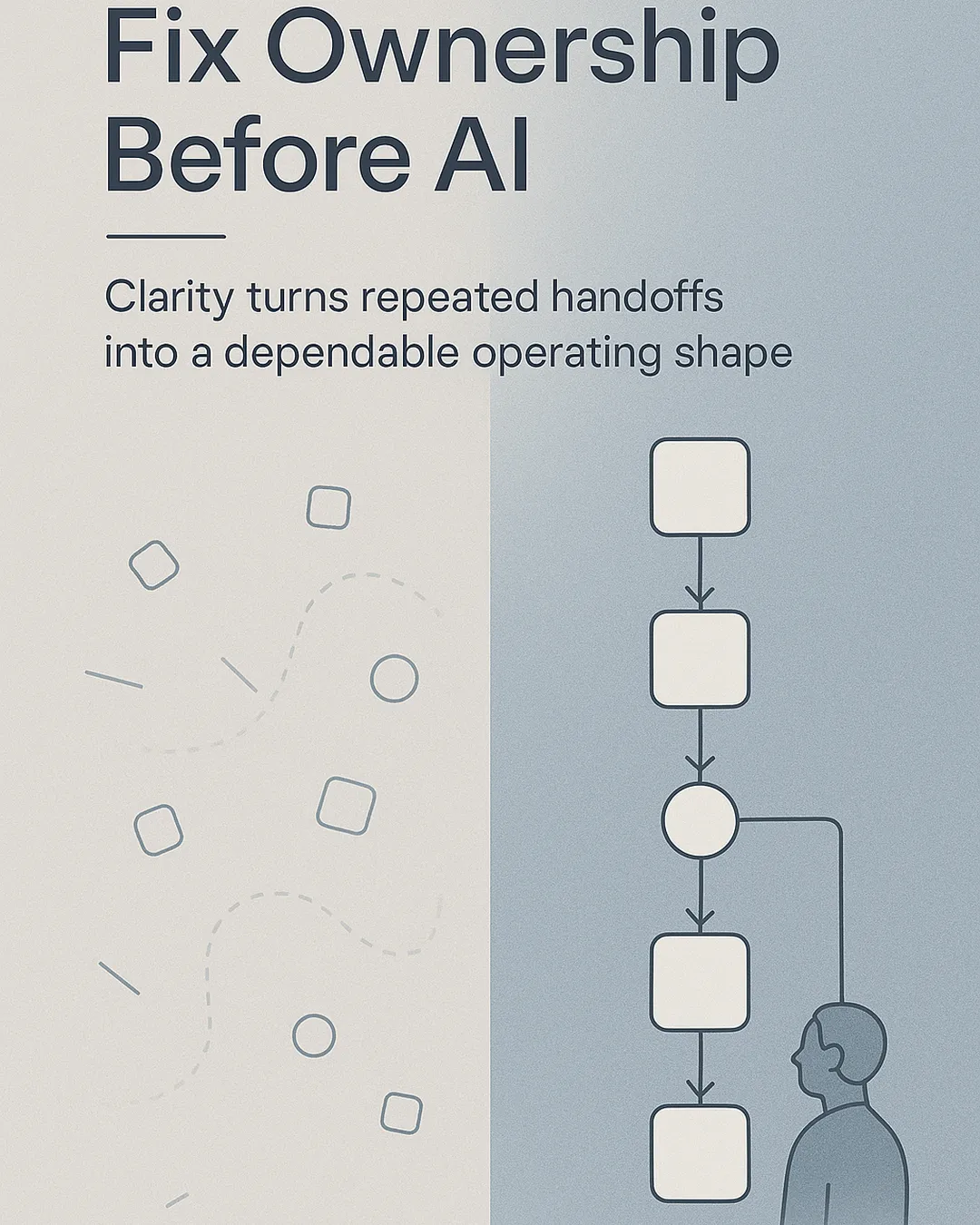
What to Fix Before Adding AI to Operations
The Real Operational Friction
Most operators don’t wake up thinking they need AI. They wake up to small breaks that keep repeating. A customer email sits because nobody is sure who answers it. A lead gets entered twice, then not at all. A delivery exception gets handled three different ways depending on who noticed it first. Someone asks, “Did we ever send that quote?” and the room goes quiet while everyone searches through threads, tabs, and memory.
The work is getting done, but it’s getting done *through people*, not through a dependable operating shape. You can feel it in the way meetings become status hunts, in the way the same questions return every week, and in the way “quick fixes” pile up—new tags, new fields, new steps—without making the day any calmer.
This is the friction: not a lack of effort, but a lack of operational ownership. When ownership is unclear, everything becomes a handoff, and every handoff becomes a chance for drift.
Why the Common Approach Fails
When the pain shows up, the most common responses are understandable: hire another person, add another system, or layer in automations. Each can help—briefly. But when the foundation is unclear, these moves tend to magnify the original problem.
Hiring more people often increases inconsistency. You bring in a capable coordinator, and for a month the inbox clears and the tasks move. Then reality returns: that person invents their own way of tracking, another person keeps doing it the old way, and now you have two versions of “done.” The new hire becomes a buffer rather than a true owner, and the business becomes dependent on their personal vigilance. When they’re out, the operation slips.
Adding tools tends to create drift. A new platform is introduced to “centralize,” but no one owns the definition of what belongs there, what “complete” means, or what happens when something is missing. People update it when they remember, or when they’re being watched, or when it helps *them* in that moment. The system doesn’t decay because people are careless; it decays because no one has defined responsibilities tied to it.
Layering automations can remove keystrokes but rarely removes ambiguity. Automations are deterministic: they do what they’re told. If the handoffs, exceptions, and decision points aren’t owned, automations simply route confusion faster. A task gets created, but no one feels accountable to close it. A notification fires, but there’s no escalation when it’s ignored. You end up with activity—alerts, pings, sequences—without accountability.
The common failure modes are the same: inconsistency, drift, ownership ambiguity, and no accountability. AI won’t fix those by itself. It will inherit them.
Reframe: Roles vs Tasks
Before adding anything intelligent, it helps to shift from “tasks that need doing” to “roles that own outcomes.” Tasks are visible and urgent. Roles are quieter but structural. A role has defined responsibilities, boundaries, and an explicit promise: *this outcome will be true, and here is how we know.*
Start with the outcomes you rely on. Examples: every inbound request is acknowledged within one business hour; every qualified lead has a next step scheduled; every order exception is surfaced the same day; every invoice discrepancy is resolved within five days. Those are not tasks. Those are owned outcomes.
Then define the role that owns each outcome, even if today it’s informally shared. Ownership means: - One primary owner, not a committee - Defined responsibilities that are specific enough to audit - A clear intake (what enters their world and from where) - A clear “done” definition (what completion means) - An escalation path (what happens when they can’t complete it) - A cadence (how often it is reviewed and by whom)
This is the point where AI employees become relevant—not as a magic layer, but as a way of *replacing repeatable roles* once those roles are cleanly defined. AI employees can carry operational ownership of a bounded role when responsibilities are explicit, inputs are consistent, and escalation rules are real. Without that, you don’t get replacement; you get another partial contributor that still requires humans to interpret, supervise, and repair.
The goal is not to sprinkle AI across tasks. The goal is to decide which repeatable role you want owned end-to-end, then make that role legible enough to be owned reliably—by a person or by AI employees.
Practical Implications
When a role is truly owned, several quiet improvements show up fast.
First, the same work stops breaking in different ways. Intake becomes consistent because it’s part of operational ownership, not a courtesy. If something arrives without required information, the role owner doesn’t “try anyway”; they follow the defined responsibilities: request the missing piece, park it in a known state, and escalate if it stalls.
Second, exceptions stop becoming leadership problems. Leaders typically get pulled in when there’s no escalation path. With a role that has explicit escalation rules, exceptions get sorted into categories: handle normally, request clarification, or escalate after a set threshold. That reduces the number of “quick questions” that interrupt the day.
Third, accountability becomes measurable without being personal. Instead of arguing about effort, you review outcomes: response time, completion rate, backlog age, and exception volume. The role is either being fulfilled or it isn’t. That clarity is what makes replacing repeatable roles possible, because you can validate whether the role is being performed to standard.
Fourth, handoffs become deliberate. If sales hands something to operations, the handoff includes required fields and a definition of ready. If it isn’t ready, it doesn’t move. That sounds strict, but it’s what prevents downstream chaos.
Finally, leaders get back attention. Not because the work disappears, but because it becomes predictable. Predictability is what creates capacity. Once roles have defined responsibilities and operational ownership, adding AI employees becomes a controlled decision: you’re not asking AI to “help wherever”; you’re assigning it a job with boundaries, inputs, and escalation.
Agentic Desk Solutions works with operators who want to introduce AI employees without importing more chaos. We start by clarifying the role: defined responsibilities, operational ownership, intake, done criteria, and escalation—so replacing repeatable roles is actually possible and measurable. We’re not here to add noise; we’re here to make one role dependable end-to-end and then determine whether it can be replaced cleanly. If you’re considering replacing a repeatable role, we can help you map it cleanly.