When Automation Makes Things Worse
The Real Operational Friction
You add a few automations because the week is getting away from you. A form submission should create a record, send a confirmation, notify the right person, and move the work along. Instead, it creates a second record, sends the wrong email, and pings three people who all assume someone else is handling it. The customer replies to a message nobody is watching. A deal gets marked “won” because a trigger fired, not because payment cleared. A refund request lands in a shared inbox, gets tagged, and then disappears into silence.
None of this looks like a catastrophe in the moment. It looks like small, plausible glitches: one-off exceptions, edge cases, “we’ll fix it later.” But the volume of these exceptions grows as you add more steps. Your team starts compensating with workarounds—manual checks, shadow spreadsheets, side conversations. Leaders end up doing triage instead of leading. And the most damaging part is that it becomes hard to tell whether the business is actually performing or simply being propped up by constant human patching.
Why the Common Approach Fails
The usual response is to throw more coverage at the problem. If automations are dropping things, you hire an ops coordinator. If follow-ups are inconsistent, you add an SDR. If handoffs keep failing, you add a project manager. Headcount can temporarily mask the gaps, but it also creates new ones: different people interpret the same process differently, exceptions get handled in private, and the “right way” becomes tribal knowledge. Inconsistency becomes normal.
Next comes adding tools. A new system for intake, another for messaging, one more for reporting. Each tool promises clarity, but the stack often increases operational entropy: the same customer exists in three places, statuses don’t match, and everyone has a different source of truth. The more surfaces you create, the more places there are for drift to accumulate.
Then you layer automations on top of all of it. A trigger is added to “fix” a delay. Another trigger is added to “fix” the first trigger. Soon, nobody can confidently answer basic questions: What’s supposed to happen next? Who is responsible if it doesn’t? Where do we see that it failed?
These approaches share the same failure modes:
- Inconsistency: Different inputs create different outcomes, and the business quietly accepts variation as inevitable. - Drift: What started as a clean workflow slowly diverges as exceptions, shortcuts, and patches pile up. - Ownership ambiguity: When something breaks, the answer is “I thought the system handled that,” or “I assumed sales owned it,” or “Ops was supposed to catch it.” - No accountability: If no one has operational ownership, there’s no reliable loop for detection, correction, and prevention—only reaction.
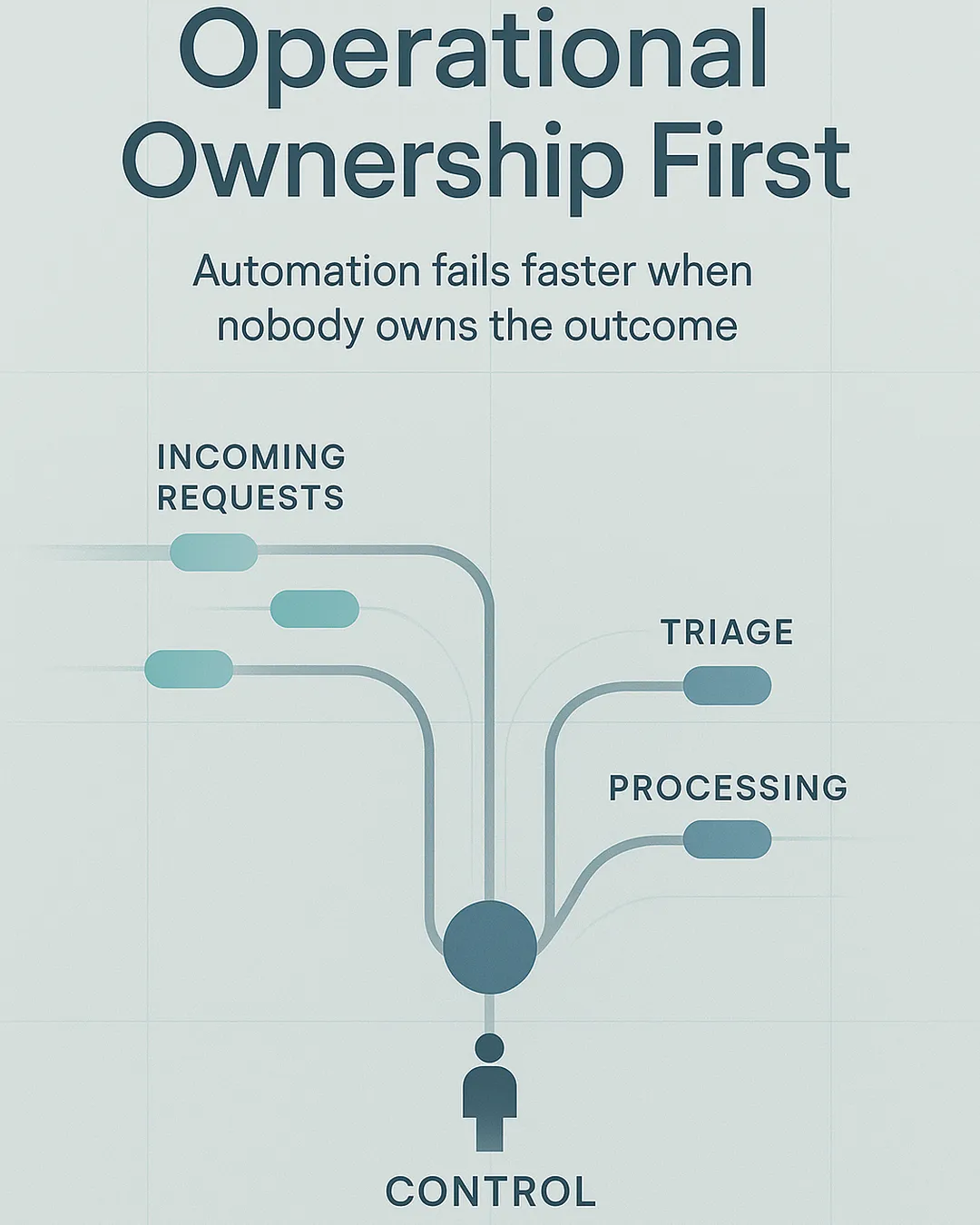
Automation makes things worse when it accelerates a process that doesn’t have clear ownership. It moves faster, but it moves faster into confusion.
Reframe: Roles vs Tasks
Most businesses try to automate tasks: “Send the email,” “create the record,” “update the status,” “assign the ticket.” Tasks are visible and measurable. But tasks are not the unit that keeps a business stable. Roles are.
A role is not a job title and it’s not a list of clicks. A role has defined responsibilities: what outcomes it must produce, what standards count as “done,” and what it must watch for when reality diverges. A role has operational ownership: a single accountable owner who is responsible for the result, not just the action. And a role has escalation: when conditions aren’t met, where does it go, how quickly, and what is the fallback?
When you automate tasks without role clarity, you get silent failure. The task executes, but nobody is accountable for the outcome. The system “did its job,” yet the customer experience degrades because the role never existed to begin with.
This is where AI employees become relevant—not as a magic layer on top of chaos, but as a way to think about replacing the function of a repeatable role. The question is not “What can we automate?” The question is “What role is being performed, what are its defined responsibilities, and can that role be executed consistently without human drift?”
Replacing repeatable roles only works when the role is properly described. That description must include what the role monitors, what exceptions look like, and what happens when an exception occurs. Without that, any automation—no matter how clever—will simply do the wrong thing faster and more consistently.
Practical Implications
When a role is owned, several operational problems stop being mysterious.
First, quality becomes inspectable. If the Intake Owner is responsible for every new request being categorized, confirmed, and routed, you can measure whether intake is consistent. If the Follow-up Owner is responsible for response timing and next steps, you can see when follow-up slips and why. Ownership turns “we think it’s fine” into “we know it’s working.”
Second, exceptions stop becoming emergencies. With operational ownership, there’s a defined place for edge cases to go. That means fewer surprises, fewer last-minute Slack pings, and fewer leaders pulled into preventable rescues. The business doesn’t eliminate exceptions—it stops being destabilized by them.
Third, drift becomes correctable. When a process degrades over time, someone with defined responsibilities notices and is accountable to restore standards. Without that, teams normalize decay until the only solution feels like a rebuild.
Finally, leaders get time and clarity back. Instead of spending mornings reconciling mismatched records, interpreting half-true dashboards, or asking “did anyone reply to that customer,” leadership can focus on capacity planning, service quality, and the actual bottlenecks that affect growth. The business becomes easier to run because the work is structured around roles, not scattered tasks.
Automation becomes helpful only after the role is clear. Otherwise, it becomes a multiplier of ambiguity.
Agentic Desk Solutions works with operators to identify where automation is currently amplifying confusion, then map roles with defined responsibilities and operational ownership so replacing repeatable roles becomes possible without breaking the business. We don’t start with tasks; we start with what must be true every day for operations to be stable, and where escalation should happen when it isn’t. If you’re considering replacing a repeatable role, we can help you map it cleanly.