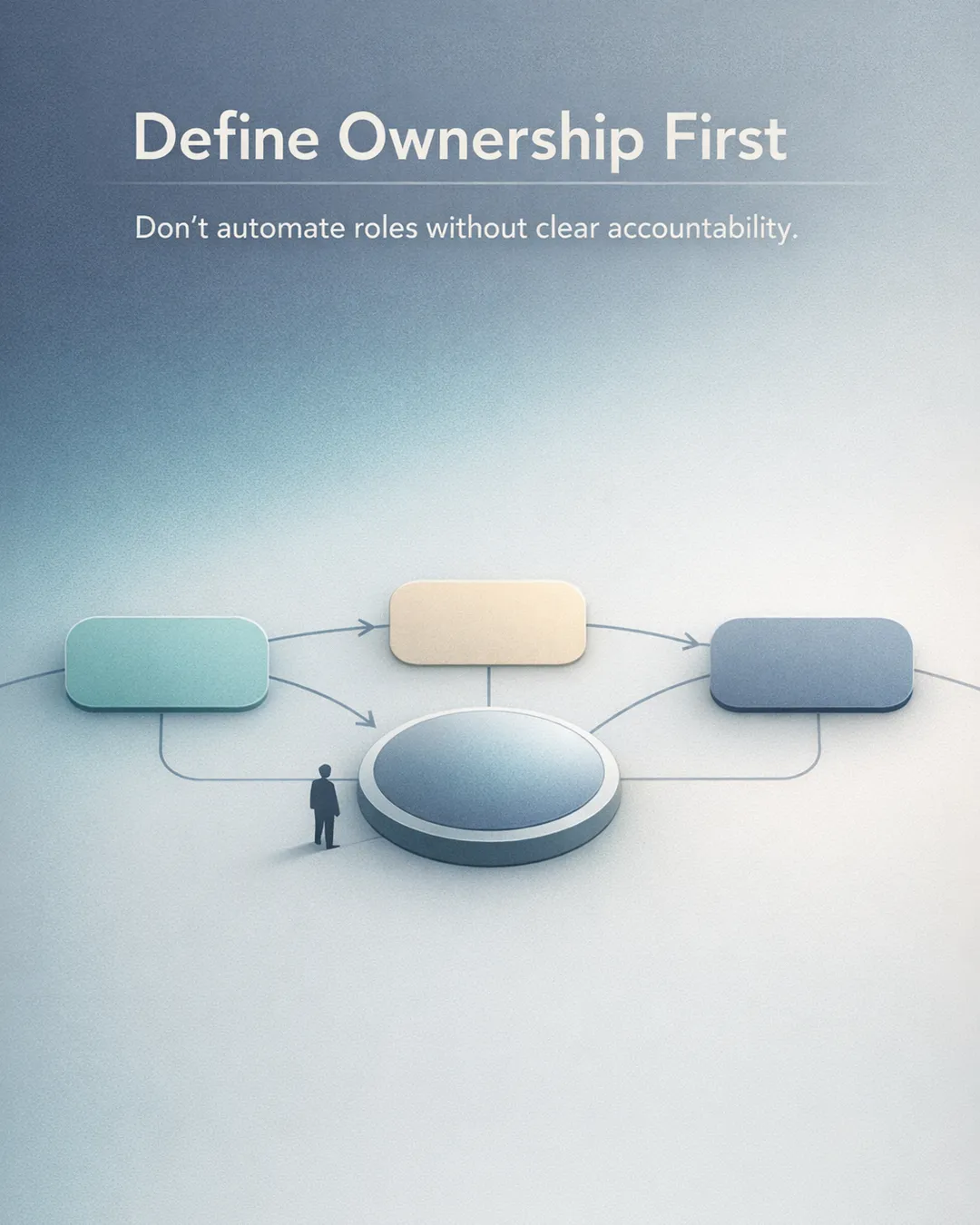
When Not to Automate: The Roles That Need Ownership First
The Real Operational Friction
Most operational problems don’t show up as a dramatic failure. They show up as a slow, daily grind: leads that sit too long before anyone responds, invoices that go out with small errors, customer requests that bounce between inboxes, and internal handoffs that feel like a relay race with no baton. Someone “fixes it” in the moment, and the business moves on—until the next fire.
Over time, you start to see the pattern. The same questions get asked repeatedly. The same edge cases keep derailing the day. Team members do their best, but outcomes vary depending on who is on shift, what mood the customer is in, or how busy the office feels. You don’t lack effort—you lack a stable way to produce the same result every time.
That’s where the temptation to automate creeps in. If the work is repeatable, why not make it automatic? The friction is real. But automating the wrong thing doesn’t remove friction—it often hides it, spreads it, and makes it harder to correct.
Why the Common Approach Fails
When a process hurts, the most common responses are predictable: hire another person, add another system, or layer automations on top of what already exists. Each can help in isolation, but they often fail for the same underlying reasons.
Hiring more people seems like the fastest relief. But without defined responsibilities, you’re not adding capacity—you’re adding variation. Two people interpret the same request differently. One is diligent about notes, the other “will do it later.” One escalates issues early, the other tries to be helpful and silently improvises. The output becomes inconsistent, and leadership gets pulled back into constant clarification.
Adding tools has a similar effect. Tools don’t create operational ownership; they create new places for work to live. Now a request might be in email, a ticketing system, a spreadsheet, or a shared inbox. Each addition increases the surface area for drift. People stop trusting the system because it’s never fully current, so they work around it—then the tool becomes a shadow record instead of the source of truth.
Layering automations can be the most deceptive. A workflow fires, messages send, statuses update, tasks get created—yet the real work still depends on judgment, context, and escalation. When an automated sequence hits an exception, no one is clearly accountable for resolving it. Ownership ambiguity creeps in: “I thought the system handled that.” Or worse: “I saw it, but I assumed someone else would.”
The core failure modes are consistent:
- Inconsistency: the same input produces different outcomes based on who touches it and what they remember. - Drift: what was “the process” slowly changes without anyone noticing, until it no longer matches reality. - Ownership ambiguity: everyone is involved, so no one is responsible. - No accountability: issues are discovered late, and correction happens as a scramble rather than a controlled response.
Automation can’t fix those. If anything, it can amplify them by moving work faster through a system that still doesn’t have clear responsibility.
Reframe: Roles vs Tasks
A useful way to decide when not to automate is to stop thinking in tasks and start thinking in roles.
A task is an action: send an email, update a record, schedule a call, process a refund. A role is a stable unit of work with defined responsibilities, clear inputs and outputs, and an escalation path when something doesn’t fit. Roles have standards. Roles have boundaries. Roles have a person—or a system—accountable for outcomes.
Most businesses try to automate tasks while leaving the role undefined. That’s how you end up with automated reminders, auto-responses, auto-routing, auto-tagging—yet customers still complain, records still decay, and exceptions still get mishandled. The automation is doing motion, not ownership.
So when should you *not* automate?
You should not automate when: - The work requires judgment but you haven’t defined what “good judgment” means in operational terms. - Exceptions are common, but escalation rules are informal (“just ask Sarah”). - Quality is evaluated by vibe or memory rather than clear acceptance criteria. - The handoff between teams isn’t explicit (sales “throws it over the wall” to ops, ops “tries to figure it out”). - The business relies on “hero corrections” to keep customers happy.
In those situations, automation doesn’t create reliability. It creates speed without control.
This is where AI employees become relevant—not as a magic layer, but as a way to think about *replacing repeatable roles* once the role itself is structured. An AI employee is only effective when the role has operational boundaries: what it owns, what it must produce, what it is allowed to decide, and when it must escalate. Without that, you don’t have a role to replace—you have a messy set of tasks with hidden dependencies.
The reframe is simple: don’t automate tasks you don’t have the courage to assign to a role with clear accountability. Define the role first. Then decide whether the role should be handled by a person—or whether you are ready for *replacing repeatable roles* with AI employees.
Practical Implications
When a role is truly owned, a few things change immediately—even before you “improve the process.”
First, outcomes stabilize. Not perfect, but predictable. The same input gets the same handling because the role has defined responsibilities and standards. That predictability is what makes improvement possible; you can’t refine what keeps changing shape.
Second, exceptions stop being emergencies. A well-owned role includes escalation rules: what is routine, what is out of scope, what needs approval, and what gets handed off. When those rules exist, the business doesn’t rely on tribal knowledge. Problems surface early and move to the right decision-maker without drama.
Third, systems stay cleaner. Most operational systems decay because no one owns the integrity of the record. “Someone should update it” becomes “everyone assumes someone else did.” With operational ownership, there is a named owner for data quality and follow-through, which reduces rework and internal distrust.
Finally, leaders get time back in a specific way. Not just fewer tasks—but fewer clarifying conversations, fewer “can you check this one?” pings, fewer end-of-week surprises. Leadership can focus on decisions and constraints rather than acting as the human router for everything that doesn’t fit neatly.
The point isn’t to avoid automation forever. It’s to avoid automating ambiguity. Automation works best after the role is defined, the outputs are measurable, and escalation is built in. Then automation can support a role—or an AI employee can take the role on—without the business losing control of quality.
Agentic Desk Solutions helps operators define roles with clear operational ownership, then evaluate whether those roles are suitable for AI employees and *replacing repeatable roles* without breaking what already works. We focus on capturing defined responsibilities, boundaries, and escalation so the work stays consistent instead of drifting over time. If you’re considering replacing a repeatable role, we can help you map it cleanly.