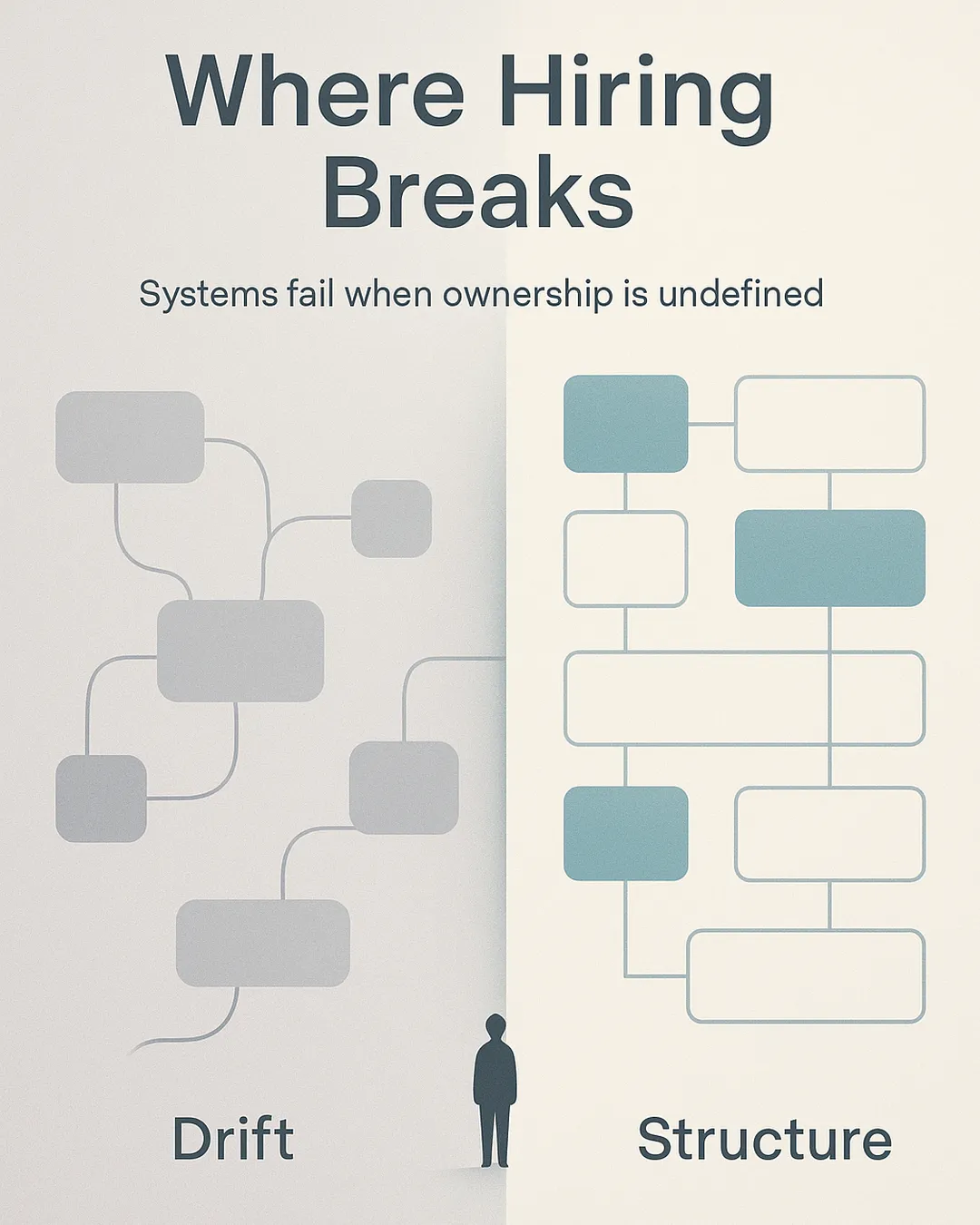
Why hiring breaks before systems do
The Real Operational Friction
At some point, a growing business stops feeling “busy” and starts feeling unstable. You’re not short on effort. You’re short on predictability. A customer calls and gets a great experience on Monday, then a confusing one on Thursday. Leads sit in a queue because the person who “usually handles that” is out. The same question gets answered three different ways depending on who saw the message. Someone updates a record, someone else overwrites it, and now nobody trusts what they’re looking at.
You respond the only way you can: you jump in. You triage. You patch gaps with memory and hustle. You add a quick check-in, a shared doc, a reminder to “make sure we’re doing this every time.” For a week or two, it improves. Then the volume rises, a new hire starts, a senior person shifts focus, and the whole thing slips again.
What makes it frustrating is that nothing is *broken enough* to justify a full rebuild—yet everything is broken enough to drain leadership attention daily.
Why the Common Approach Fails
When the friction shows up, most owners take one of three paths: hire more people, add more tools, or layer automations. Each can help in the short term. Each often fails for the same underlying reasons.
Hiring more people can increase capacity, but it also increases variation. Two smart employees can interpret the same request differently. Training becomes tribal knowledge: “Ask Jamie, she knows how we do it.” Over time, you get inconsistency across shifts, across accounts, and across channels. Then you try to correct it with meetings and checklists, which creates more overhead. The business grows, but the operating method becomes harder to keep stable.
Adding tools usually feels like progress because it creates a place to “put” the work. But tools don’t create operational ownership. They create options: multiple ways to log something, multiple ways to tag it, multiple ways to close it out. People choose the path of least resistance. A month later, reports don’t match reality, fields are blank, and everyone has their own workaround. That’s not a tool problem; it’s ownership ambiguity wearing a software mask.
Layering automations can be even worse when the underlying work isn’t well-defined. Automations fire based on assumptions that drift over time: a stage means one thing to sales, another to operations. A trigger sends follow-up even when a human already handled it. Exceptions pile up, and the team starts saying, “Ignore those messages,” which trains everyone to distrust the system. That’s drift—the gap between what you intended and what actually happens.
Across all three approaches, the failure mode is the same: no accountability for the *role*. Tasks get done when someone remembers, or when a manager catches it, or when a customer complains. When that’s the operating model, hiring just adds more moving parts to manage.
Reframe: Roles vs Tasks
Most businesses try to solve operational friction by distributing tasks. “Who can send the follow-up?” “Can someone update the record?” “Can you cover the inbox for an hour?” Tasks get assigned, reassigned, and patched together. It works until it doesn’t, because tasks don’t have a home.
A role is different. A role has defined responsibilities, a clear owner, and boundaries: what’s included, what’s not, what “done” means, and what happens when something doesn’t fit. A role also has an escalation path. That’s where stability comes from—not from effort, but from structure.
Here’s the key distinction:
- Task thinking asks: *Who can do this right now?* - Role thinking asks: *Who owns this outcome every time?*
When you hire under task thinking, you often get a capable person who becomes a catch-all. They plug holes, learn exceptions, and keep things afloat through personal heroics. That can look like performance. But it’s fragile. When they’re out, the work collapses because the “system” was their judgment.
Under role thinking, you can define operational ownership in a way that survives turnover and growth. You can see where responsibilities overlap, where they’re missing, and where they’re being implicitly handled by leadership.
This is also where AI employees become relevant—not as a magic layer over chaos, but as a way to assign repeatable work to a consistent role with clear boundaries. The goal isn’t “using AI.” The goal is replacing repeatable roles that are currently handled through ad hoc effort and constant supervision. If the responsibilities are defined, the work is repeatable, and escalation is clear, then replacement becomes a practical decision rather than a gamble.
Importantly, this doesn’t remove humans from the business. It removes humans from being the glue for processes that should be stable.
Practical Implications
When a role is owned, several things improve quickly—even before any replacement happens.
First, handoffs stop being mysterious. Instead of “I thought you had it,” you get a clear line: the role owns intake, qualification, follow-up, record updates, or whatever the function is. That clarity reduces delays and reduces internal messaging volume, because fewer things need clarification.
Second, exceptions become manageable. A role with defined responsibilities also has defined non-responsibilities. When something falls outside the role, it escalates the same way every time. That prevents quiet work avoidance (“I wasn’t sure, so I left it”) and prevents quiet scope creep (“I handled it this time, so now it’s always mine”).
Third, quality becomes measurable. If nobody owns the outcome, you can’t improve it—because you can’t locate the failure. With operational ownership, you can track what “good” looks like: response times, completion rates, accuracy, and resolution. Inconsistency becomes visible and correctable rather than an ongoing irritation.
Finally, leadership gets time back. Not by delegating more tasks, but by removing the need to constantly interpret, remind, and chase. The business feels calmer because the same inputs produce the same outputs more often. When you do need to hire, you hire into roles with boundaries instead of adding another person to the swirl.
This is why hiring often breaks before systems do. Hiring adds capacity, but without role clarity it also adds variability. Systems—meaning the way responsibilities are defined and owned—are what make that capacity reliable.
Agentic Desk Solutions helps business operators turn fragile task bundles into stable roles with clear operational ownership and defined responsibilities, then evaluate where AI employees can take over by replacing repeatable roles without creating new ambiguity. If this sounds familiar, a short consult is the fastest way to scope whether a role can be replaced.