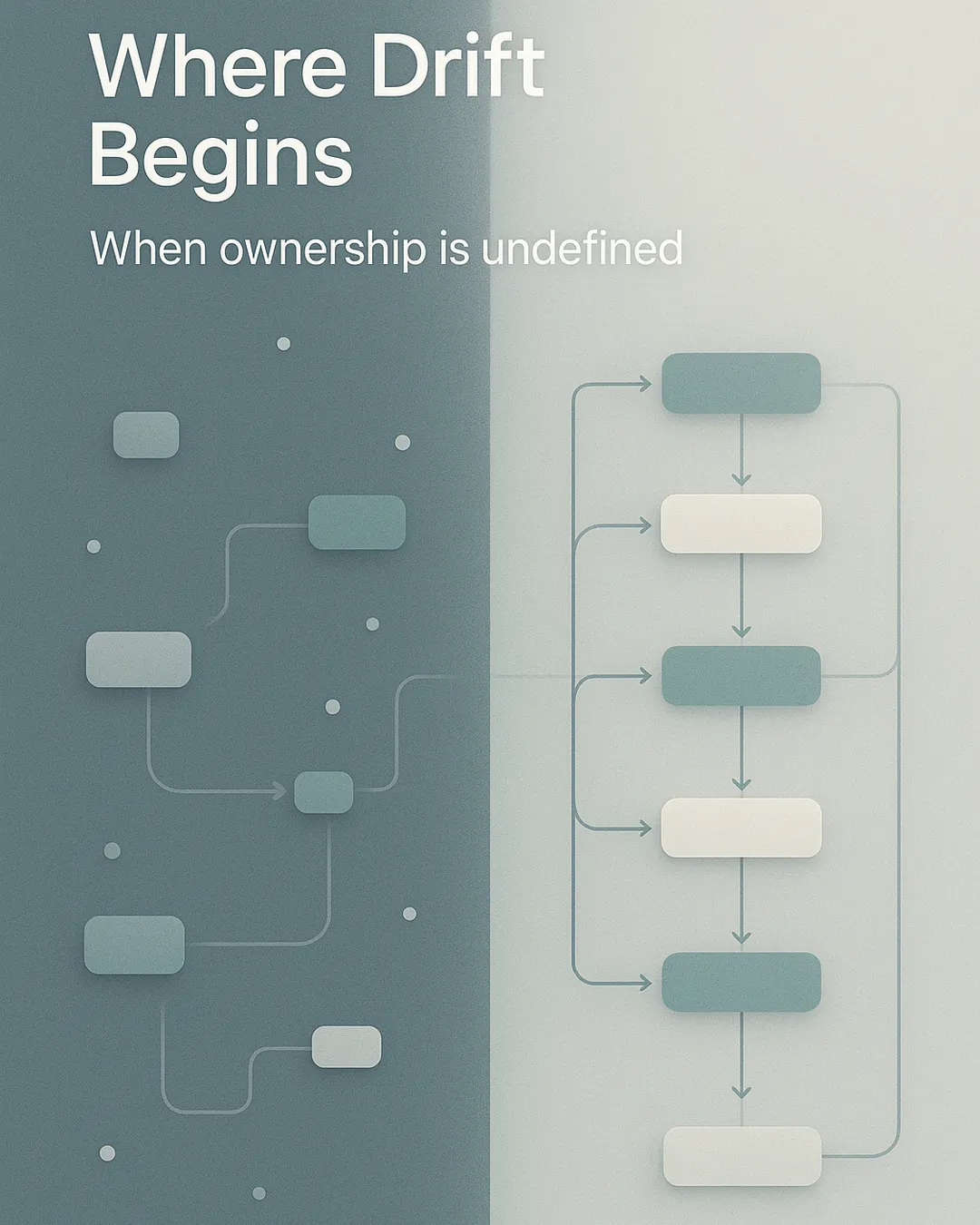
Why Humans Drift and Systems Don’t
The Real Operational Friction
Most operational problems don’t start as big failures. They show up as tiny inconsistencies that stack up: a lead gets called “soon” but not today, an invoice gets sent “after this meeting,” a customer request sits in a shared inbox because “someone will grab it,” and the person who *usually* catches these things is out sick.
At first, everyone compensates. A manager starts scanning threads at night. A senior rep builds their own checklist. A coordinator becomes the unofficial traffic cop who remembers what’s urgent. It works—until it doesn’t. When the volume ticks up or a key person leaves, the same business that felt “busy but fine” suddenly feels slippery. You can’t predict outcomes from effort. Two people do the same task differently. The same request gets three different answers depending on who saw it first.
The friction isn’t laziness or a bad attitude. It’s drift: the normal, human tendency to interpret, prioritize, and adapt in ways that slowly pull work away from consistency.
Why the Common Approach Fails
When drift shows up, the instinct is understandable: hire more people, add more software, and layer in automations to “keep things from falling through the cracks.” The problem is that these moves usually increase activity without improving operational ownership.
Hiring more people often creates *more* variation. New hires bring different assumptions and habits. Training happens once, then reality takes over. Under pressure, people default to what’s easiest to remember, not what’s most consistent. The result is inconsistency: the same lead is handled differently; the same exception gets different treatment; the same customer gets a different experience depending on who is on shift. Without defined responsibilities, extra headcount adds surface area for drift.
Adding tools can be worse if ownership is unclear. A new system creates another place work can live. People start “working around” it when it’s inconvenient. Now you have two sources of truth, and everyone argues about which one counts. That’s drift at the system level: processes slowly detach from reality because no one is responsible for maintaining the connection.
Layering automations can hide the problem temporarily while creating bigger failures later. Automations fire based on assumptions that change over time. When no one owns the role end-to-end, those assumptions aren’t reviewed. You get ownership ambiguity: the automation sent the message, but who checks the response? It created the ticket, but who validates it’s complete? It moved the status, but who confirms the work actually happened?
Across all three, the same failure mode appears: there’s activity without accountability. Everyone is doing tasks, but no one is accountable for the outcome. When something breaks, it becomes a group mystery instead of a correctable process.
Reframe: Roles vs Tasks
Drift becomes manageable when you stop thinking in tasks and start thinking in roles.
A task is “send a quote.” A role is “ensure quotes go out within four business hours, are accurate, and are followed up until accepted or closed-lost.” The difference is that a role has boundaries, expectations, and—most importantly—operational ownership.
To define a role in a way that resists drift, you need a few basics:
- Defined responsibilities: what the role is responsible for, in plain language. Not a job description, but measurable outcomes (response time, completeness, handoff accuracy). - Ownership: who is responsible when the outcome isn’t met. Not who “touched it,” but who owns the result. - Escalation: what happens when the role hits an exception (missing info, angry customer, edge-case request). Where does it go, and how fast? - Handoffs: what “done” means before work moves to the next role. This prevents partial completion from masquerading as progress.
When these elements exist, humans can still do the work, but the work no longer depends on human memory and interpretation alone. You reduce the room for drift because the role itself has rails.
This is also where *AI employees* become relevant—not as a bolt-on helper, but as a way to hold a repeatable role steady. The point of *AI employees* is not to “do random tasks.” It’s to execute a role with consistent boundaries, follow the same defined responsibilities, and escalate when conditions aren’t met. That is the practical meaning of replacing repeatable roles: not replacing people, but replacing the specific work patterns that require constant human vigilance to keep consistent.
Practical Implications
When a role is truly owned, several things improve quickly—and quietly.
First, exceptions become visible. Drift thrives in ambiguity; ownership exposes where reality doesn’t match expectations. You find out which inputs are missing, which handoffs are unclear, and which “quick questions” are actually recurring work. Instead of blaming people, you tighten the role until it can be executed reliably.
Second, fewer things “almost happen.” In many businesses, work isn’t missing—it’s incomplete. A lead is contacted but not qualified. A ticket is created but not routed. A renewal is noted but not executed. With operational ownership, “done” becomes non-negotiable, and partial completion stops passing as progress.
Third, leaders get time back in a specific way. Not “more free time,” but fewer interruptions. The constant pings—“Did we respond?” “Who’s handling this?” “What’s the status?”—drop because there’s a clear owner, clear escalation, and predictable output. That reduces the need for managers to act as human glue.
Finally, replacing repeatable roles becomes a practical decision rather than a philosophical one. You can look at a role and say: is it bounded, repeatable, and measurable? Does it have stable inputs and clear escalation? If yes, it’s a candidate for *AI employees*. If not, you’ll see what needs to be defined first. Either way, you stop guessing and start managing the work as a system.
Agentic Desk Solutions helps operators turn drifting work into owned roles that can be executed consistently, including when it makes sense to use AI employees for replacing repeatable roles. The starting point isn’t software or headcount—it’s clarifying defined responsibilities and establishing operational ownership with clean escalation paths. If you’re considering replacing a repeatable role, we can help you map it cleanly.